

The KJ Method was developed by Jiro Kawakita to help people work with diverse observations from field research and discover patterns, problems, and new ideas. It became widely known through his 1967 book Hassōhō (The Method of Idea Generation). The method is sometimes reduced to sorting sticky notes during a meeting. Its more distinctive aim, however, is not to force observations into a predefined classification system, but to develop meaningful relationships and groupings by attending carefully to the data themselves.
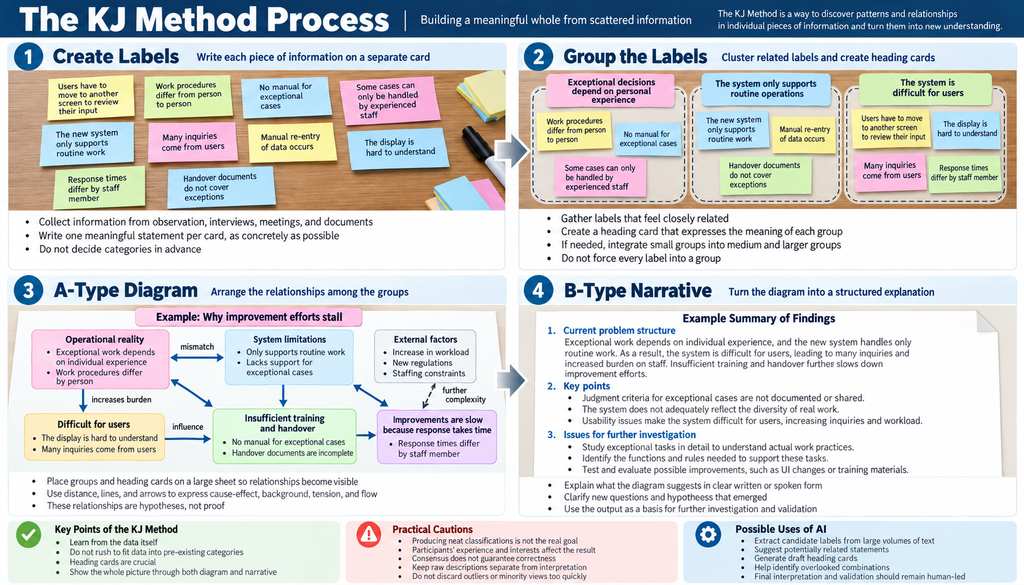
The KJ Method in its narrower sense can be described in four stages: (1) making labels, (2) forming groups and writing group headings, (3) creating a diagram (Type A), and (4) presenting the results in writing or speech (Type B narration). Kawakita also developed a broader approach encompassing fieldwork and repeated cycles of this process.
1. Making Labels — Record Each Observation
Start with a question or a problematic situation, and gather materials through observation, interviews, open discussion, or document review. Write each meaningful observation or statement on a separate card or sticky note. A brief sentence such as “Employees repeatedly switch screens to verify previously entered information” retains more useful context than a label such as “Poor usability.” Keep the original source, date, and speaker separately when they matter.
Avoid assigning cards to predefined categories such as “Human factors” or “System factors” at this stage. Choosing the explanatory framework before examining the material risks excluding observations that do not fit it.
2. Forming Groups — Gather Labels and Create Meaningful Headings
Spread the labels out and read them repeatedly. Gradually bring together two or three labels that seem to belong together, paying attention to what the particular statements have in common. Then create a group heading that expresses the meaning emerging from those statements, rather than simply imposing a familiar category name.
For example, consider three labels: “Work procedures differ by employee,” “The handover guide omits exceptional cases,” and “Some cases can be handled only by experienced staff.” A useful heading could be “Judgments about exceptional cases depend on individual experience.” This stays closer to the observations than immediately calling the whole group “Insufficient training.”
Treat a completed group heading as a new label. Groups can then be combined into larger groups where appropriate. Do not force every remaining card into a group: an outlier may point toward a problem that the emerging structure has not yet captured.
3. Type A Diagram — Arrange and Relate the Groups
Arrange the groups on a large surface so that their relationships become visible. Place closely related groups near each other, circle groups, and add lines or arrows for relationships such as causes and effects, background conditions, conflicts, or feedback loops. In Japanese KJ practice, outlining a group is sometimes called shimadori (“island outlining”).
For example, “Judgments about exceptional cases depend on individual experience” may connect to another cluster headed “The new system handles only routine work.” This suggests a problem different from simply describing employees as “resistant to change.” A line drawn on the diagram, however, does not prove causation; it may express a hypothesis to investigate.
4. Type B Narration — Turn the Diagram into an Explanation
The process does not end with a tidy diagram. Describe what the whole arrangement suggests: which observations belong together, where the tensions lie, what is still unclear, and which new questions emerge. The explanation can take the form of a written account or oral presentation.
In the example above, one possible hypothesis is: “The difficulty of adopting the new system may result partly from tacit knowledge about exceptional work that was not incorporated into the system, rather than from staff attitudes alone.” The next step would be to examine actual work records and investigate those exceptional cases. Generating a hypothesis and testing it are separate activities.
What the Method Does — and Does Not — Establish
The aim is not simply to finish a classification table or produce consensus among participants. A central principle is to resist treating an established theory as an automatic explanation and instead learn from the material. In this respect, the method has an affinity with the original motivation behind Grounded Theory, although the two have different histories and procedures.
Judgments about which labels are related, and how they should be named, inevitably reflect participants’ experience and interests. A KJ diagram does not disclose the single objectively correct classification of the world. Preserve unusual observations and disagreements, keep links to original material, and distinguish interpretation from evidence. Group agreement can support shared understanding without proving that the result is true.
The KJ Method in the AI Era
LLMs can help extract candidate labels from large collections of text, suggest possible groupings, and propose alternative headings. But if AI begins by generating generic categories and then allocates observations to them, it may undermine the exploratory purpose of the KJ Method.
A more appropriate design would preserve the original statements and their sources while allowing people to inspect and revise labels, groups, and headings. AI might also surface unexpected relationships or observations that resist the current grouping. These are promising possibilities rather than guaranteed improvements, and their value requires evaluation.
The KJ Method is not a universal procedure for finding correct answers. Its enduring lesson is that we should observe before organizing, examine meaning before assigning categories, and return to the original evidence before declaring a conclusion.
Related Pages
- Organize Information | From Categories to Structure
- Think Together | Dialogue and Collective Judgment
- Concept Formation and Categorization | Change the Categories, Change What You See
- Qualitative Data Analysis | Learn from the Subject Before Applying a Theor
References
Japan’s Vocational Development Database — KJ Method (Japanese)
Jiro Kawakita, Hassōhō (The Method of Idea Generation), 1967.
Jiro Kawakita, Zoku Hassōhō, 1970.
Kawakita Research Institute — About the KJ Method
Jiro Kawakita, “The KJ Method and My Dream Towards Heuristic Regional Geography,” 1973