

The Analytic Network Process (ANP) is a mathematical decision-making method that evaluates alternatives while accounting for dependencies and feedback among evaluation criteria and other decision elements. It was developed by Thomas L. Saaty, the creator of the Analytic Hierarchy Process (AHP), as a generalization of AHP that extends beyond hierarchical structures.
In AHP, a decision problem is decomposed into a hierarchy consisting of goals, evaluation criteria, and alternatives. Pairwise comparisons are used to determine the relative importance of different elements. However, evaluation criteria in real-world decision problems are not always independent.
For example, when evaluating research and development projects, technical feasibility may influence development costs, while development costs may affect market competitiveness. Market growth prospects may also influence the resources available for R&D and the direction of technological development.
If criteria are evaluated independently without considering these relationships, important aspects of the decision problem may be overlooked.
ANP addresses this limitation by representing decision elements as an interconnected network and calculating their overall priorities while accounting for dependencies and feedback.
The defining characteristic of ANP is that it treats decision-making as a network of interdependent elements rather than a simple hierarchy, using pairwise comparisons and matrix calculations to quantify their relative influences.
However, introducing a network structure does not mean that every type of interaction or nonlinearity can be represented accurately. Understanding the mathematical foundations of ANP is essential for recognizing both its capabilities and its limitations.
Differences Between AHP and ANP
AHP generally represents decision problems as hierarchical structures in which relationships proceed from higher-level objectives to lower-level criteria and alternatives. Criterion weights are typically determined independently of the alternatives.
For example, suppose a company is evaluating three R&D projects—A, B, and C—using technical feasibility, market potential, and development costs as criteria.
In AHP, the relative importance of the criteria is determined through pairwise comparisons. Each project is then evaluated under each criterion, and the results are combined through a weighted aggregation procedure.
In reality, however, technical feasibility may influence development costs. Higher development costs may affect market competitiveness. The selection of a particular technology may also change the equipment, personnel, and capabilities required, potentially affecting the relative importance of the evaluation criteria themselves.
ANP can explicitly incorporate these dependencies and feedback relationships into the evaluation model.
| Aspect | AHP | ANP |
|---|---|---|
| Basic structure | Hierarchy | Network |
| Relationships | Primarily hierarchical | Dependencies and feedback |
| Priority calculation | Pairwise comparisons and eigenvectors | Pairwise comparisons and supermatrices |
| Dependencies among criteria | Not explicitly modeled in conventional AHP | Explicitly represented |
| Computational complexity | Relatively simple | Potentially complex |
| Typical application | Multi-criteria evaluation with a hierarchical structure | Multi-criteria evaluation involving interdependencies |
ANP is a generalization of AHP, but it is not necessarily superior in every situation. When dependencies among criteria are relatively weak and a hierarchical representation is sufficient, AHP may be easier to understand and require substantially less input.
Network Structure in ANP
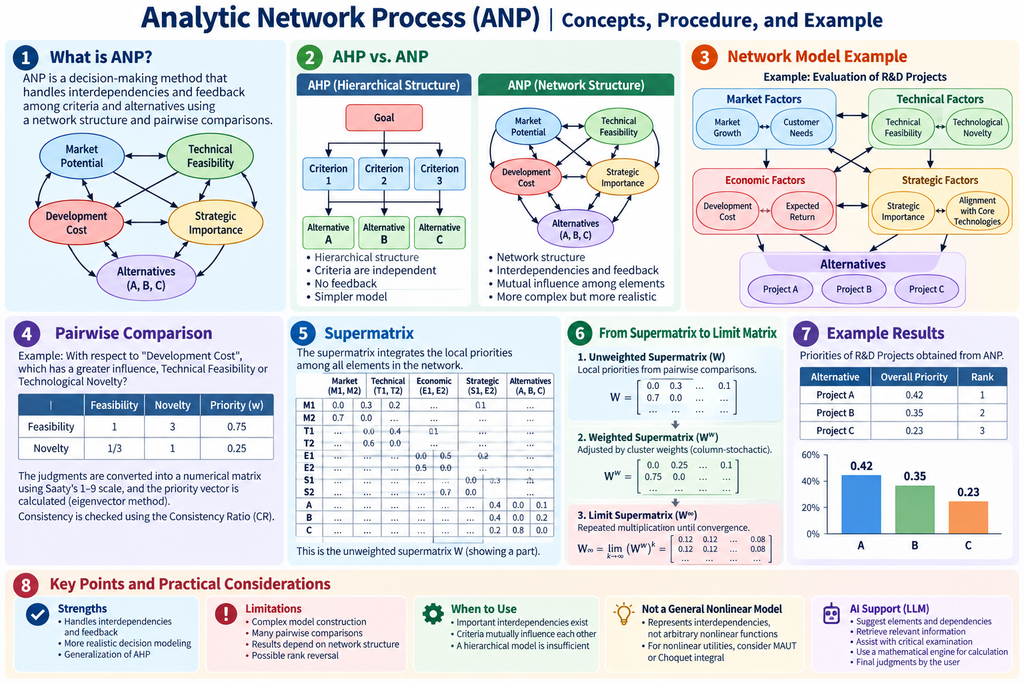
ANP organizes decision elements into groups called clusters.
For example, an R&D project selection model might contain the following clusters.
Technical Factors: Technical feasibility, technological novelty, compatibility with existing technologies.
Market Factors: Market growth, competitive advantage, customer needs.
Economic Factors: Development costs, required investment, expected returns.
Alternatives: R&D Project A, Project B, and Project C.
Dependencies are then defined among elements within and across these clusters.
For example, if technical feasibility influences development costs, this relationship can be incorporated into the network.
ANP supports two important types of dependency.
Inner Dependence refers to relationships among elements within the same cluster. For example, technological novelty and technical feasibility may influence each other.
Outer Dependence refers to relationships between elements belonging to different clusters. For example, technical feasibility may influence economic factors such as development costs.
ANP also permits feedback structures in which element A influences element B while B influences A.
However, an important distinction must be made.
An ANP link does not necessarily represent a physical or causal relationship. It may instead represent the relative influence or importance of one decision element with respect to another.
Consequently, an ANP network serves a different purpose from a causal Bayesian Network or a feedback model in system dynamics.
Quantifying Dependencies Through Pairwise Comparisons
Like AHP, ANP relies on pairwise comparisons.
However, the questions asked in ANP are more complex than simply determining which of two criteria is more important.
For example, a comparison might ask:
“With respect to development costs, which has a greater influence: technical feasibility or technological novelty?”
Such comparisons estimate the relative influence of elements concerning a particular controlling element.
ANP commonly uses Saaty’s Fundamental Scale, also employed in AHP.
| Value | Meaning |
|---|---|
| 1 | Equal influence |
| 3 | Moderate influence |
| 5 | Strong influence |
| 7 | Very strong influence |
| 9 | Extreme influence |
| 2, 4, 6, 8 | Intermediate judgments |
The resulting pairwise comparison matrices are used to calculate local priority vectors, commonly through the principal eigenvector method.
As in AHP, the Consistency Ratio (CR) can be used to examine the internal consistency of judgments.
However, ANP may require pairwise comparisons for numerous relationships throughout the network. As the number of elements and dependencies increases, the number of comparisons can become substantial.
This represents one of the major practical difficulties of ANP.
Moreover, even perfectly consistent pairwise comparisons do not guarantee that the underlying network structure is appropriate.
Supermatrix Calculations
The mathematical feature that most clearly distinguishes ANP from AHP is the supermatrix.
A supermatrix combines the relative influences among network elements into a single matrix.
The rows and columns represent decision elements, and the matrix entries represent local priorities derived from pairwise comparisons.
When elements are grouped into clusters, the supermatrix can be divided into blocks corresponding to relationships between clusters.
ANP generally uses three stages of supermatrix calculation.
1. Unweighted Supermatrix
The Unweighted Supermatrix contains local priority vectors obtained from pairwise comparisons.
Each block represents the relative influence of elements in one cluster with respect to elements in another cluster.
Entries corresponding to relationships that do not exist in the network are normally zero.
At this stage, a column may contain contributions from several clusters, so the sum of its entries is not necessarily equal to 1.
2. Weighted Supermatrix
The Weighted Supermatrix adjusts the unweighted supermatrix by incorporating the relative importance or influence of the clusters.
In conventional ANP calculations, the resulting matrix is generally made column-stochastic, meaning that the entries in each column sum to 1.
This normalization allows the influences represented in the network to be combined through repeated matrix multiplication.
However, the values should be interpreted as relative priorities or influences rather than probabilities of real-world events.
3. Limit Supermatrix
The Limit Supermatrix is obtained by repeatedly multiplying the weighted supermatrix by itself.
Let W denote the weighted supermatrix.
The process can be expressed as:
W² = W × W
W³ = W × W × W
Wᵏ = W × W × ... × W
Repeated multiplication combines influences transmitted through increasingly long paths within the network.
When the sequence converges, the limit matrix is:
W∞ = lim(k→∞) Wᵏ
The limiting priorities can then be used to determine the relative priorities of decision elements and alternatives.
However, convergence is not guaranteed for every network.
The behavior depends on the mathematical properties of the weighted supermatrix, including connectivity and periodicity.
For an irreducible and aperiodic column-stochastic matrix, repeated multiplication converges to a stable limiting structure under the usual finite-state conditions.
Other network structures may produce periodic behavior or multiple limiting classes, requiring different computational treatment.
It is therefore important to verify convergence rather than simply assuming that repeated multiplication will always produce a unique solution.
The resulting values represent aggregated relative influences within the ANP model. They should not be interpreted as event probabilities or as the physical propagation of causal effects.
Example: Selecting R&D Projects
Consider a company evaluating three research and development projects.
- Project A: Short-term development aimed at improving existing technologies.
- Project B: Applied research intended to enter a new market.
- Project C: Fundamental technology research intended to establish long-term competitive capabilities.
Suppose the company uses four evaluation criteria: technical feasibility, market potential, development costs, and strategic importance.
Under conventional AHP, each criterion would receive a weight, and the three projects would be evaluated and ranked through weighted aggregation.
However, several dependencies may exist.
Technical feasibility influences the resources required for development. Technically difficult projects may demand greater investment. At the same time, projects with high market potential may justify larger development expenditures.
Project C presents an additional challenge. Although its immediate market potential may be limited, its strategic importance as a foundation for future technologies could be substantial.
ANP allows the decision-maker to represent relevant dependencies among these factors.
For example, pairwise comparisons might address questions such as:
“Which has a greater influence on development costs: technical feasibility or development time?”
“Which contributes more strongly to strategic importance: market growth or technological novelty?”
The local priorities are incorporated into the supermatrix, and the network’s aggregate priorities are calculated.
The resulting rankings may differ from those produced by conventional AHP.
For instance, AHP might rank Project B highest because of its market potential, while ANP might favor Project A after accounting for dependencies involving feasibility and development costs.
This is only a hypothetical illustration. Actual rankings depend on the network structure and the pairwise judgments supplied by decision-makers.
Furthermore, the project ranked highest by ANP is not necessarily objectively superior.
The value of ANP lies in examining whether dependencies among evaluation factors lead to different conclusions from those obtained through a simpler hierarchical model.
Does ANP Provide Nonlinear Evaluation?
Although ANP extends AHP by incorporating dependencies and feedback, modeling interdependencies is not equivalent to representing arbitrary nonlinear evaluation functions.
Consider the selection of a rental apartment.
The importance of distance from the nearest railway station may depend on commuting frequency. Someone who commutes five days a week may place much greater value on station proximity than someone who works from home.
ANP can introduce relationships among station proximity, commuting frequency, and other decision factors.
However, defining such dependencies does not automatically establish a conditional utility function specifying exactly how the value of station proximity changes with commuting frequency.
For this type of problem, conditional weighting, nonlinear utility functions, or Multi-Attribute Utility Theory (MAUT) may provide a more direct representation.
Similarly, when two criteria produce a synergistic effect, non-additive aggregation methods such as the Choquet integral may be appropriate.
For example, technological expertise and manufacturing capability might jointly produce greater competitive value than the sum of their individual contributions.
ANP can account for dependencies among these factors through its network structure and priority calculations, but it is not a general-purpose method for estimating arbitrary nonlinear functions.
The existence of dependencies among decision elements and the nonlinear interaction of criteria in determining utility are related but mathematically distinct problems.
Recognizing this distinction is important when choosing an appropriate decision-making model.
Differences from Bayesian Networks and System Dynamics
ANP, Bayesian Networks, and system dynamics all use network structures, but they represent different kinds of relationships and produce different kinds of results.
A Bayesian Network represents probabilistic dependencies among variables. Each variable has a probability distribution, and conditional probability tables define its relationship to parent variables.
The network can then calculate posterior probabilities based on observed evidence.
ANP, by contrast, calculates relative priorities derived from pairwise judgments. Although its matrix calculations may resemble some forms of probability propagation, the resulting numerical values do not represent the probabilities of events.
System Dynamics models how system variables change over time through stocks, flows, and feedback mechanisms.
For example, increased R&D investment may improve technological capabilities, leading to greater revenue, which in turn enables further R&D investment.
System dynamics can simulate how such feedback processes evolve over time.
ANP also permits feedback structures, but conventional ANP does not directly simulate temporal changes in system variables.
Repeated multiplication of the supermatrix is a mathematical process for aggregating network influences, not a simulation of successive real-world time periods.
The methods can therefore be distinguished as follows.
| Method | Primary Objective | Meaning of Numerical Results |
|---|---|---|
| ANP | Prioritization with interdependencies | Relative priorities |
| Bayesian Network | Probabilistic reasoning under uncertainty | Probabilities |
| System Dynamics | Analysis of system behavior over time | State variables, rates of change, and trajectories |
These methods are better understood as complementary tools for addressing different kinds of problems rather than competing approaches to the same task.
Limitations and Practical Considerations
The first major limitation of ANP is its complexity.
Although dependencies can be modeled flexibly, users must define the network structure, organize elements into clusters, and perform pairwise comparisons for the relevant relationships.
As the network becomes larger, the burden of providing judgments increases substantially.
A second limitation concerns the validity of the network structure.
Real-world decision factors may have numerous relationships, but including every conceivable relationship is not necessarily beneficial.
Adding weak or poorly justified dependencies may increase model complexity without improving decision quality.
A third limitation concerns the interpretation of supermatrix calculations.
Even if the calculations converge, the resulting priorities may not provide meaningful guidance if the network structure, pairwise judgments, or cluster weights are inappropriate.
A fourth issue is the potential for rank reversal.
As with AHP, changes in the alternatives, network structure, or evaluation model may alter the relative ranking of existing alternatives.
For these reasons, ANP should not be treated as a mechanism that automatically generates correct decisions simply because it uses sophisticated mathematics.
Sensitivity analysis is particularly valuable.
Users can modify dependency relationships, pairwise comparison values, and cluster weights to examine how these changes affect the final rankings.
Comparing ANP results with those obtained through conventional AHP can also provide useful insights.
If the rankings differ substantially, the analyst should investigate which dependencies are responsible for the difference and whether those relationships are sufficiently justified.
The objective is to understand the decision structure, not merely to produce a numerical ranking.
ANP in the Age of AI
Large Language Models (LLMs) offer new opportunities to reduce the effort required to construct and examine ANP models.
Traditionally, analysts had to identify relevant decision factors, organize them into clusters, define dependencies, and complete numerous pairwise comparisons.
These requirements made ANP considerably more demanding than conventional AHP.
With LLM assistance, users can describe a decision problem in natural language and receive suggestions for evaluation criteria, relevant factors, and possible dependencies.
For example, a user might enter:
“We want to evaluate our R&D projects based on technical feasibility, market potential, and economic performance.”
An LLM could suggest additional factors, organize them into clusters, and propose possible relationships among them.
It could also search technical literature, market research, and company documents for information relevant to those relationships.
However, an LLM-generated network structure is not necessarily valid.
Relationships inferred from general knowledge may not apply to a particular company, project, or industry.
Similarly, the relative influence values suggested by an LLM should not automatically be accepted as representing the decision-maker’s judgments.
A more appropriate division of responsibilities is to use the LLM to assist with network construction and information retrieval, allow users to confirm relationships and pairwise judgments, and perform supermatrix calculations using a dedicated mathematical engine.
LLMs can also assist with critical examination of the results.
For example, an LLM might raise questions such as:
- Is it appropriate to treat technical feasibility and development costs as separate evaluation elements?
- Are market potential and expected returns being counted twice?
- How would the rankings change if a particular dependency were removed?
- Are important relationships missing from the network?
- Would a simpler AHP model produce substantially different results?
These questions can guide users toward revising the network and repeating the calculations.
In this way, combining ANP with LLMs may reduce the burden of model construction while encouraging deeper examination of the assumptions underlying the evaluation.
ANP in ThinkNavi
ThinkNavi approaches ANP as a mathematical thinking method for examining decisions involving interdependent evaluation criteria and feedback relationships.
AHP provides a relatively straightforward way to organize criteria hierarchically and determine their relative importance.
ANP extends this approach by introducing a network structure that allows dependencies among criteria, clusters, and alternatives to influence the resulting priorities.
However, ANP is more demanding than AHP and is not necessarily appropriate for every decision problem.
If implemented in ThinkNavi Free, ANP could provide capabilities such as visual network and cluster editing, pairwise comparisons, consistency checking, supermatrix calculation, sensitivity analysis, and comparison with conventional AHP results.
These functions would be consistent with ThinkNavi’s policy of making manually operated mathematical thinking and analysis tools freely available.
A future LLM-assisted version could help users identify relevant elements, propose dependencies, retrieve supporting information, and critically examine the resulting models.
ANP could also become part of the broader ConceptMiner product family.
For example, R&D hypotheses and technology development themes generated through ConceptMiner R&D could be evaluated using AHP or ANP, depending on the structure and complexity of the decision problem.
Nevertheless, greater model complexity does not necessarily produce better decisions.
A practical approach may be to begin with AHP and introduce ANP when important dependencies among evaluation criteria become apparent.
This makes it possible to examine whether incorporating dependencies materially changes the conclusions without requiring every decision to be modeled as a complex network from the outset.
The value of ANP does not lie in constructing complicated networks for their own sake. It lies in recognizing the limitations of treating evaluation criteria as independent and examining whether their interdependencies lead to a more appropriate understanding of the decision problem.
Related Thinking Methods:
- Analytic Hierarchy Process (AHP) | Quantifying Evaluation Criteria Through Pairwise Comparisons
- Multi-Criteria Decision Analysis (MCDA) | Mathematical Approaches to Integrating Multiple Criteria and Value Judgments
- Decision Matrix | Comparing Alternatives Across Multiple Criteria and Evaluating Decision Validity
- Nonlinear Utility Theory | Mathematical Models of Human Value Judgments and Risk Preferences
- Choquet Integral | Modeling Synergy and Redundancy Among Evaluation Criteria
- Bayesian Networks | Structuring Uncertainty and Reasoning with Probabilistic Models
- System Dynamics — Modeling Feedback Mathematically to Understand How Systems Change Over Time
- SWOT and TOWS Analysis,
- DEMATEL,
- Sensitivity Analysis | Examining How Changes in Assumptions Affect Model Results
References and Further Reading
- Thomas L. Saaty, Decision Making with Dependence and Feedback: The Analytic Network Process, RWS Publications, 1996.
- Thomas L. Saaty, “Decision Making — The Analytic Hierarchy and Network Processes (AHP/ANP),” Journal of Systems Science and Systems Engineering, 13(1), pp. 1–35, 2004.
- Thomas L. Saaty, “Fundamentals of the Analytic Network Process — Dependence and Feedback in Decision-Making with a Single Network,” Journal of Systems Science and Systems Engineering, 13(2), pp. 129–157, 2004.
- Thomas L. Saaty and Luis G. Vargas, Decision Making with the Analytic Network Process, Springer, 2006.
- Enrique Mu, Orrin Cooper, and Michael Peasley, “Best Practices in Analytic Network Process Studies,” Expert Systems with Applications, 159, Article 113536, 2020.
- Saaty — Fundamentals of the Analytic Network Process
- Saaty — Decision Making: The Analytic Hierarchy and Network Processes
- Best Practices in Analytic Network Process Studies