

As a preliminary step to building a conceptual structure model for concept research, you can automatically collect text chunks.
Free-form Prompt
You can collect arbitrary text chunks using free-text prompts, according to categories specified by the user (social surveys, market research, etc.). For example, you can generate ideas by entering prompts such as “problems with using social media” or “problems with life in old age.” Alternatively, you can directly instruct the system to generate ideas such as “new service ideas in the XX field.” The output text chunks can also be automatically coded in a GTA-like manner. The created table of text chunks is saved as a CSV file. In the subsequent Model and Explore steps, the text chunks are grouped (clustered) by similarity and linked in a network diagram, which has the same effect as the KJ method.
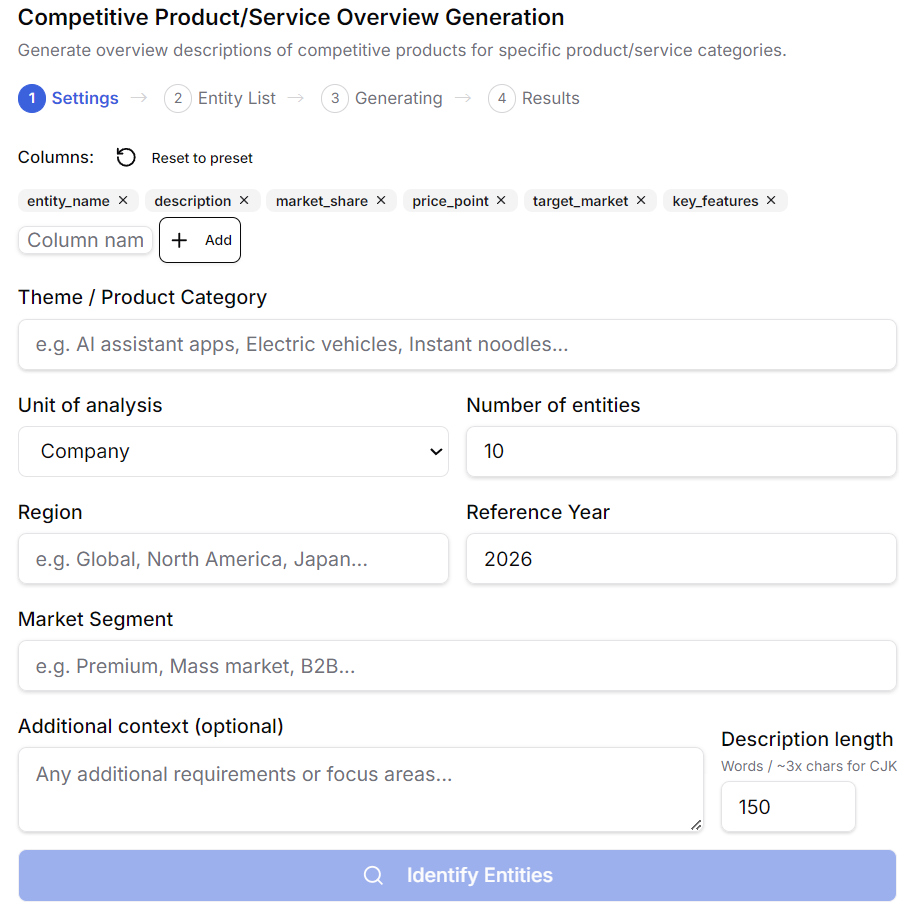
Competitive Product/Service Overview Generation
You can collect text chunks based on a user-specified theme and perform competitive analysis of products and services in the market. These text chunks represent an overview of the product or service, and by building a conceptual structure model based on them, you can position the product or service concept in a multidimensional space. When you actually try it, you will see that it can capture the nuances of information with accuracy equivalent to, or even better than, positioning based on quantitative data. Coding similar to GTA is also possible.
Competitive Concept Collection
Users input specific descriptive text, and the system collects descriptions of real-world products and businesses that compete with their concept (idea). This can be used in the Hypothesis Diabnosis step to compare the user’s created concept with those of other companies. By creating a concept map from the collected text in the Concept Mapping and exploration step, users can pre-examine the market positioning of their hypothesis.
Sensory Experience Description Generation
Textual descriptions of sensory experiences with food and beverages will be collected. Of course, AI cannot directly experience taste or aroma, so it will use knowledge learned from publicly available information on the internet. While this utilizes AI knowledge, it is just a suggestion; using texts written in natural language by sensory analysis experts describing sensory experiences would also be effective. Traditional sensory evaluation has rephrased subjective experiences using quantitative scales and primarily employed methods like principal component analysis for positioning. However, positioning using natural language text will likely become recognized as an alternative method in the future. Natural language can express more subtle nuances, allowing for a more detailed analysis of differences between products. GTA-like coding is also possible.
Online Article Collection
This service searches news articles from sources such as Google News (free), News API (API key required), and Super API News (API key required) using keywords specified by the user.
Academic Paper Search
Abstracts are collected from OpenAlex (free), Semantic Schalar (free), arXiv (free), and IEEE Explor (API key required).
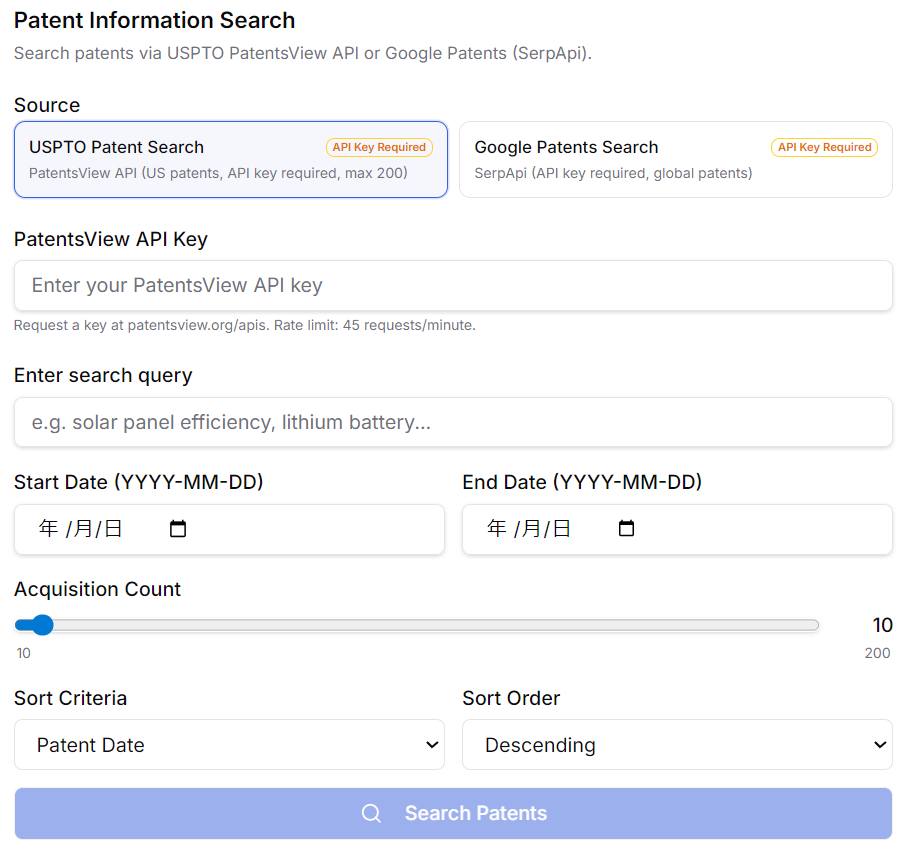
Patent Information Search
Search patent information from the USPTO (API key required) and Google Patents (API key required).
Concept Extraction
To create mindware content, we generate tables composed of multiple types of text chunks and codes from the text of a document.
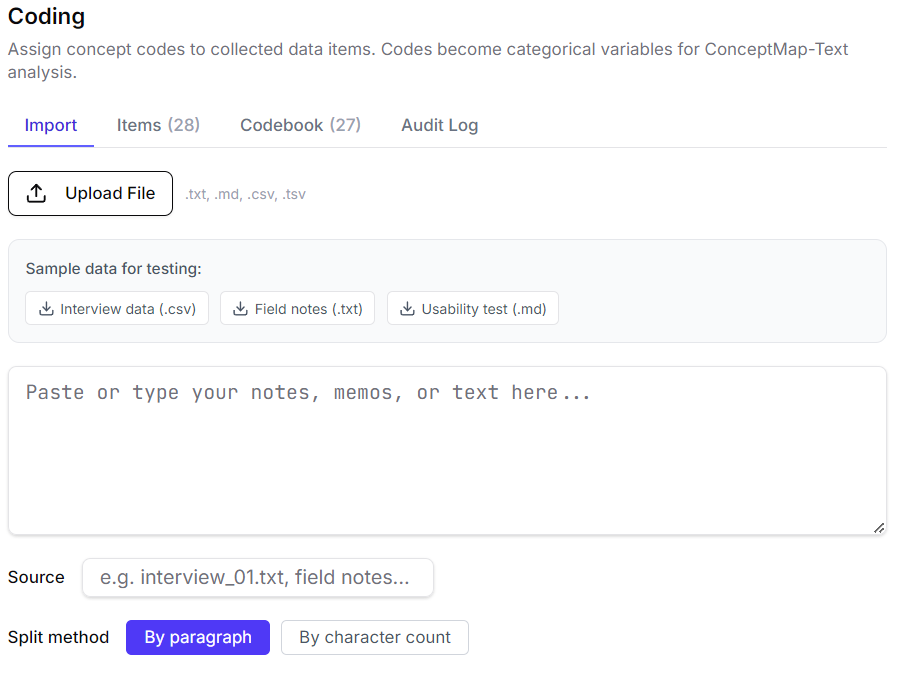
Coding
You can import data such as interview data, field notes, and usability test data (txt, md, csv, tsv) and perform GTA-style coding. Coding can be automated with AI assistance.
File Management
The data created above can be saved as a CSV file and edited, such as by deleting unnecessary rows. The saved data will be used to build the model in the Model and Explore step.