

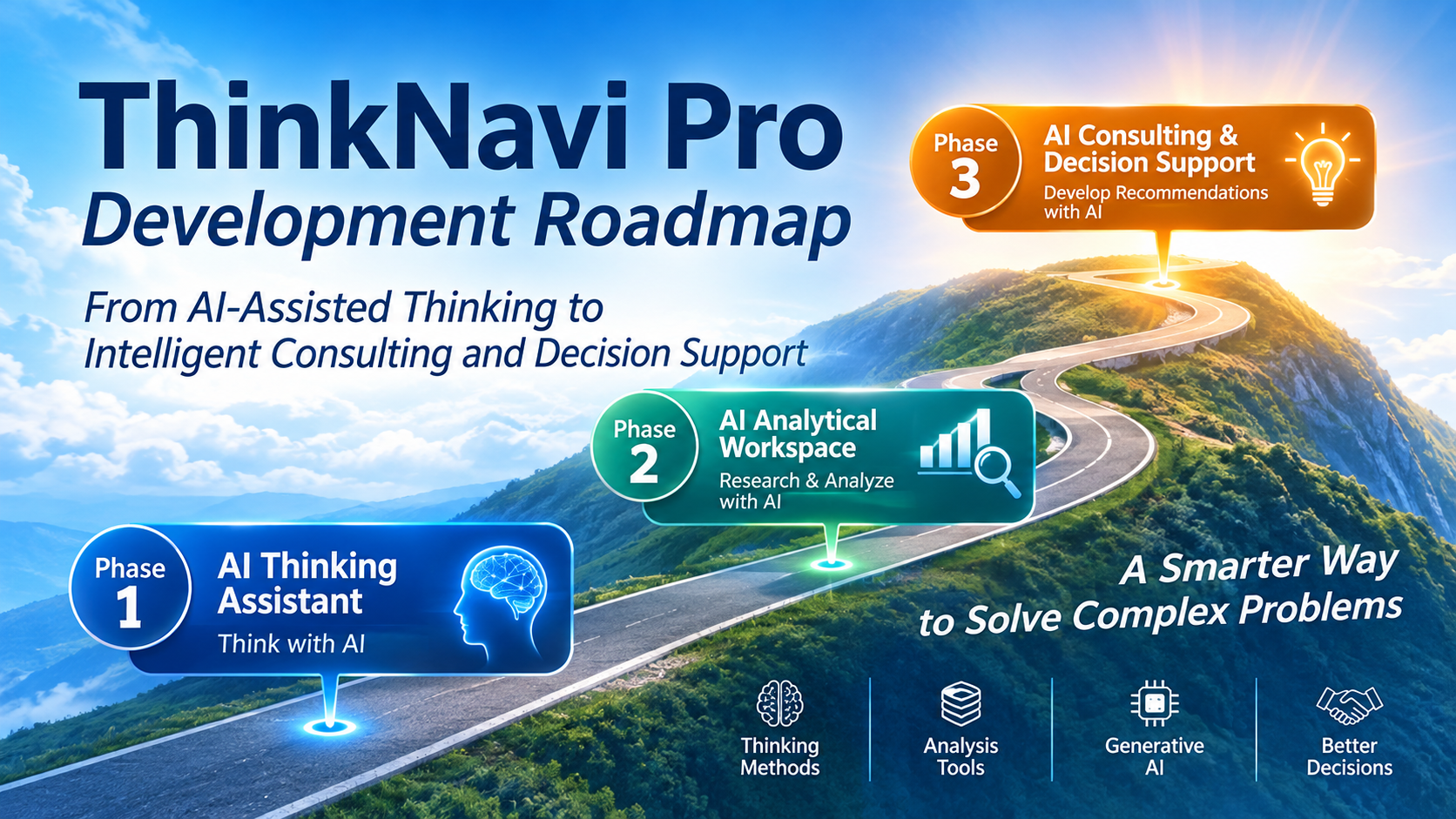

From AI-Assisted Thinking to Intelligent Consulting and Decision Support
Our Vision for the Future of ThinkNavi Pro
ThinkNavi Pro is envisioned as an AI-assisted environment that helps business professionals think critically, analyze information, explore alternatives, and develop evidence-based recommendations.
Our long-term ambition is to enable organizations to perform more of the intellectual work traditionally supported by consultants and analytical specialists.
Rather than creating a system that simply generates answers, we aim to develop a platform that supports the entire process of inquiry—from problem framing and analytical method selection to information analysis, hypothesis generation, evaluation, and recommendations.
We currently envision this development in three broad phases.
Phase 1 — AI Thinking Assistant
Thinking More Effectively with AI
The first phase focuses on creating an interactive environment where users can explore problems, reconsider assumptions, develop ideas, and evaluate alternative perspectives through AI-assisted dialogue.
This phase will build on thinking-support capabilities previously explored in ThinkNavi, with particular attention to making those capabilities more visible, accessible, and practical.
Capabilities Under Consideration
AI-Assisted Dialogue
Support problem framing, reasoning, hypothesis generation, and the exploration of alternative explanations through natural-language conversations.
Specialized Thinking Tools
Provide selectable thinking-support functions, including:
- Fermi Estimation
- Analogical Thinking
- Debate
- Perspective Shifting
- Role Model Thinking
- Metacognition
Analytical Method Recommendations
Suggest appropriate thinking and analytical methods based on the user’s objectives, context, and available information.
Rather than recommending only one method, the system would help users understand alternative approaches, assumptions, and limitations.
Structured Thinking and Visualization
Present reasoning results as structured information, including comparison tables, argument maps, estimation models, and hypothesis lists.
Users would be able to examine and modify the results instead of relying entirely on conversational text.
Critical Thinking Assistance
Help identify hidden assumptions, logical weaknesses, alternative interpretations, and potential cognitive biases.
Expected Outcome
An AI thinking assistant that helps users formulate better questions, apply diverse thinking methods, and critically examine their own reasoning.
The emphasis is on expanding human thinking capabilities rather than replacing human judgment.
Phase 2 — AI Analytical Workspace
Integrating Information Research, Analysis, and Problem-Solving
The second phase aims to extend AI-assisted thinking into a more comprehensive analytical environment.
Instead of using individual thinking methods independently, users would be able to connect information gathering, qualitative interpretation, quantitative analysis, hypothesis evaluation, and reporting within a single workflow.
Capabilities Under Consideration
AI-Assisted Research
Search, collect, compare, and summarize information from relevant sources, including publications, reports, and user-provided documents.
Evidence and Source Management
Distinguish verified information from assumptions, interpretations, and hypotheses.
Support traceability by recording information sources and the evidence underlying analytical conclusions.
Integration with ThinkNavi Free
Connect AI-assisted dialogue with analytical tools such as:
- SWOT/TOWS Analysis
- Analytic Hierarchy Process (AHP)
- Multi-Criteria Decision Analysis (MCDA)
- Bayesian Belief Networks (BBN)
- Other analytical methods introduced in ThinkNavi Free
Mathematical calculations would be handled by appropriate analytical engines rather than relying solely on language-model-generated calculations.
Integrated Analytical Workflows
Combine multiple methods into coordinated processes.
For example, users could move from problem framing and idea generation to strategic analysis, quantitative evaluation, and critical review.
Project and Knowledge Management
Organize analytical projects, retain hypotheses, preserve decision histories, and reuse previous analytical results.
Automated Report Generation
Generate structured reports documenting objectives, methods, assumptions, evidence, findings, limitations, and recommendations.
Expected Outcome
An AI-assisted analytical workspace that helps users carry out structured research and analysis projects while maintaining transparency and control over the process.
This phase aims to move ThinkNavi beyond conversational assistance toward practical support for professional analytical work.
Phase 3 — AI Consulting & Decision Support
Toward AI-Assisted Analytical Consulting
The third phase represents our longer-term vision.
We aim to explore how AI can support more complex analytical and advisory activities that have traditionally required specialized consulting expertise.
These may include business opportunity exploration, strategic planning, technology assessment, evaluation of competing alternatives, and the preparation of actionable recommendations.
Our objective is not to replace executive judgment or the human aspects of consulting, such as organizational leadership, negotiation, and stakeholder relationships.
Instead, we aim to make sophisticated analytical capabilities more accessible to organizations and their employees.
Capabilities Under Consideration
AI-Driven Analytical Planning and Execution
Develop analytical plans based on the user’s problem, select relevant methods, and coordinate multiple research and analysis tasks.
Users would retain control over important assumptions, decisions, and actions.
Advanced Hypothesis Generation and Validation
Generate alternative explanations and strategic hypotheses, compare supporting and contradictory evidence, and identify areas requiring further investigation.
Enterprise Data Integration
Support analysis of internal documents, customer information, operational records, and other business data through appropriately secured connections.
Access permissions, confidentiality, and organizational data policies would need to be respected throughout the process.
Integration with ConceptMiner
Connect ThinkNavi’s analytical workflows with ConceptMiner’s technologies for discovering underlying data structures, exploring conceptual relationships, and identifying new hypotheses or business opportunities.
Strategic Option Evaluation
Compare alternatives through multiple analytical perspectives, including business value, feasibility, risks, uncertainty, and implementation conditions.
Recommendations and Action Planning
Synthesize analytical findings into strategic recommendations, supporting arguments, validation requirements, and potential implementation plans.
Analytical Transparency and Auditability
Maintain traceable records of assumptions, data sources, analytical methods, intermediate results, and the reasoning behind recommendations.
This would help users review the process, challenge conclusions, and revise analyses when new evidence becomes available.
Expected Outcome
An AI-supported consulting and decision-support environment that enables business professionals to conduct more sophisticated analyses and develop recommendations with greater independence.
Human users would remain responsible for setting objectives, assessing evidence, making value judgments, and determining final decisions.
How the Three Phases Fit Together
| Development Phase | Main Objective | Principal Capabilities |
|---|---|---|
| Phase 1 — AI Thinking Assistant | Think with AI | Dialogue, thinking methods, method recommendations, critical reflection |
| Phase 2 — AI Analytical Workspace | Research and analyze with AI | Information research, analytical tool integration, evidence management, reporting |
| Phase 3 — AI Consulting & Decision Support | Develop recommendations with AI | Coordinated analytical workflows, enterprise data, concept exploration, strategic decision support |
These phases represent a progression from supporting individual thinking tasks to supporting more comprehensive analytical and advisory processes.
However, development will not necessarily follow a rigid sequence.
Selected capabilities from later phases may be prototyped or evaluated earlier when they can provide immediate value or help validate important assumptions.
Our Guiding Principles
1. Human Judgment Remains Central
AI should support people in understanding problems, examining evidence, and evaluating alternatives—not simply replace human judgment.
2. Analytical Methods Are Tools, Not Guarantees of Truth
Every method has assumptions, strengths, and limitations.
ThinkNavi aims to encourage users to select and combine methods critically rather than treating any framework as universally valid.
3. Qualitative and Quantitative Analysis Should Work Together
Meaning, interpretation, measurement, and mathematical evaluation are complementary aspects of inquiry.
We aim to connect them within practical analytical workflows.
4. Transparency Matters
Users should be able to understand the assumptions, evidence, methods, and limitations underlying AI-assisted recommendations.
5. Continuous Validation Will Guide Development
The effectiveness of AI-assisted analysis must be evaluated through practical use, comparison with alternatives, user feedback, and appropriate validation.
Development Status and Future Plans
This roadmap describes our current development vision for ThinkNavi Pro.
It is not a commitment to specific features or release dates.
The scope, order, and timing of development will depend on technical feasibility, resource availability, user requirements, and the results of practical evaluations.
ThinkNavi Free will continue to evolve alongside this roadmap, with the goal of making a broader range of established thinking and analytical methods available without charge.
We also intend to maintain a close relationship between the analytical capabilities of ThinkNavi Free and the AI-assisted workflows envisioned for ThinkNavi Pro.
Help Shape the Future of ThinkNavi
We welcome suggestions from researchers, consultants, business professionals, educators, and anyone involved in analytical problem-solving.
Which capabilities would provide the greatest value in your work?
What types of research, analysis, or advisory tasks would you like AI to support?
Are there particular thinking methods, analytical workflows, or integration features that should receive priority?
Your feedback will help inform our future development decisions.
ThinkNavi is developed and operated by Mindware Research Institute, Inc., Japan.
