

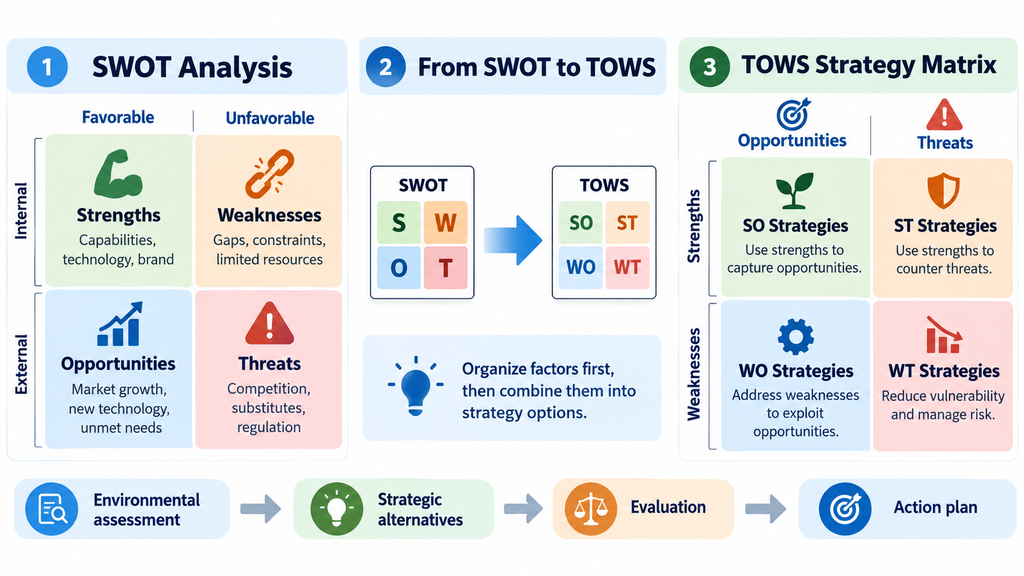
SWOT Analysis is a strategic analysis method that organizes the internal and external conditions affecting an organization, business, or project into four categories: Strengths, Weaknesses, Opportunities, and Threats. TOWS Analysis extends this approach by systematically combining these factors to generate strategic alternatives.
SWOT Analysis is widely used in corporate strategy, marketing, research and development, new business development, and organizational management. Its simple four-category framework makes it one of the most familiar tools for structuring strategic discussions.
However, a common problem with SWOT Analysis is that the process ends after identifying and listing factors in four categories. Statements such as “strong technological capabilities,” “limited sales resources,” “growing market demand,” and “intensifying competition” describe the situation but do not automatically indicate what actions should be taken.
TOWS Analysis addresses this limitation by asking how internal capabilities and external conditions can be combined to develop strategies.
For example, how can a company use its strengths to capture market opportunities? Can weaknesses be overcome to take advantage of emerging opportunities? Can existing strengths help the company respond to external threats?
These questions transform environmental observations into potential strategic actions.
SWOT Analysis provides a framework for structuring internal and external conditions, while TOWS Analysis provides a framework for generating strategic hypotheses from those conditions.
However, strategies generated through TOWS Analysis are not necessarily effective or feasible. The important task is to treat environmental analysis, strategy generation, evaluation, and validation as connected stages of strategic thinking.
Origins of SWOT Analysis and the Development of TOWS
The history of SWOT Analysis can be traced to research on long-range corporate planning during the 1960s.
Historical research published in 2023 identified the SOFT approach developed by Robert Franklin Stewart and colleagues at the Stanford Research Institute (SRI) as an important precursor to SWOT Analysis.
SOFT originally referred to Satisfactory, Opportunity, Fault, and Threat. It was designed to structure assessments of an organization’s present situation and future planning challenges.
Over time, the terminology evolved into the familiar categories of Strengths, Weaknesses, Opportunities, and Threats.
SWOT became widely adopted as a method for relating an organization’s internal characteristics to its external environment. However, identifying factors in four categories did not necessarily lead to actionable strategies.
In 1982, Heinz Weihrich published “The TOWS Matrix—A Tool for Situational Analysis,” presenting a systematic method for combining internal strengths and weaknesses with external opportunities and threats to develop strategic alternatives.
Today, strategy generation is often included within what organizations broadly call SWOT Analysis. Consequently, SWOT and TOWS are not always treated as completely separate methods.
Nevertheless, distinguishing between them remains useful because environmental assessment and strategy generation involve different thinking processes.
The Four Elements of SWOT Analysis
SWOT Analysis classifies organizational conditions according to two dimensions: whether the factors are internal or external, and whether they are favorable or unfavorable to the objective being considered.
| Favorable Factors | Unfavorable Factors | |
|---|---|---|
| Internal Environment | Strengths | Weaknesses |
| External Environment | Opportunities | Threats |
Strengths
Strengths are internal capabilities, resources, or characteristics that support the achievement of organizational objectives.
Examples include technological expertise, brand reputation, customer relationships, manufacturing capabilities, distribution networks, organizational knowledge, financial resources, and intellectual property.
However, possessing an advanced capability does not automatically make it a strategic strength.
The capability must be evaluated in relation to the intended market, competitive environment, and business objective.
For example, highly accurate measurement technology may be a significant advantage in industries where precision is essential. In a market where low cost is the primary purchasing criterion, the additional expense associated with high precision may instead become a competitive disadvantage.
A strength is therefore not an absolute characteristic. Its strategic value depends on the context in which it is used.
Weaknesses
Weaknesses are internal limitations or deficiencies that restrict the achievement of organizational objectives.
Examples include insufficient technological capabilities, limited financial resources, weak distribution networks, poor coordination among departments, and excessive dependence on a small number of customers.
The purpose of identifying weaknesses is not merely to compile a list of organizational deficiencies.
It is to understand how those limitations restrict business opportunities or increase vulnerability to external threats.
Furthermore, not every weakness needs to be eliminated internally.
Some weaknesses can be addressed through partnerships, outsourcing, technology acquisition, or changes in business strategy.
A capability that is essential in one business model may become less important under a different strategy.
Opportunities
Opportunities are external conditions or changes that may help an organization achieve its objectives.
Examples include growing markets, changing customer needs, technological developments, regulatory changes, and shifts in competitive structures.
For example, increasing demand for predictive maintenance in manufacturing may create opportunities for companies possessing relevant measurement and diagnostic technologies.
However, opportunities must be distinguished from strategic actions.
“Developing a new AI-based product” is not an external opportunity. It is a possible action that the company might take.
By contrast, “declining costs of industrial AI deployment” describes an external development that may create opportunities.
Failing to distinguish these concepts can lead to circular reasoning, in which a proposed strategy is first classified as an opportunity and then used as the justification for adopting the same strategy.
Threats
Threats are external conditions or changes that may hinder the achievement of organizational objectives.
Examples include new competitors, price competition, substitute technologies, market contraction, regulatory restrictions, and changes in customer requirements.
For example, the increasing availability of inexpensive industrial sensors from overseas manufacturers may threaten established sensor producers.
However, the same external development can create opportunities for other businesses.
Low-cost sensors may threaten companies that manufacture conventional sensors while creating new opportunities for companies developing systems that use those sensors.
Opportunities and threats are not necessarily fixed properties of external events. Their significance depends on the organization’s capabilities, objectives, and strategic position.
Defining the Scope of SWOT Analysis
One of the most important steps in SWOT Analysis is defining the subject and purpose of the analysis.
Simply deciding to conduct “a SWOT Analysis of our company” may not provide sufficient direction.
The factors considered relevant will differ depending on whether the purpose is to evaluate corporate strategy, assess the competitiveness of an existing product, or explore entry into a new market.
The same technological capability may be a major strength in an established market but insufficient to meet customer requirements in a different industry.
The time horizon also matters.
An assessment of current market conditions may produce different opportunities and threats from an analysis of the business environment expected three years into the future.
Before beginning SWOT Analysis, it is useful to clarify the target business or market, strategic objectives, planning horizon, competitors, and the organizational perspective from which the decision will be made.
How Should SWOT Factors Be Identified?
SWOT factors are often identified through brainstorming sessions involving managers and employees.
However, when participants rely only on their existing knowledge, the resulting analysis may simply reproduce assumptions they already hold.
Internal analysis can draw on information concerning technologies, personnel, equipment, finances, customers, products, and business processes.
Competitor benchmarking and frameworks such as VRIO Analysis can also help evaluate internal capabilities.
External analysis can draw on PESTLE Analysis, competitive analysis, market research, technology intelligence, customer research, and other information sources.
However, collecting information is not sufficient.
The information must be interpreted in relation to the organization’s specific objectives.
It is also important to distinguish among established facts, forecasts, hypotheses, and subjective judgments.
For example, the statement “the market is growing rapidly” may refer to verified historical data, a published forecast, or an unsupported expectation.
A well-structured SWOT Analysis should therefore record not only the content of each factor but also its evidence, source, relevant time period, and uncertainty.
Example: SWOT Analysis of an Industrial Measurement Equipment Manufacturer
Consider a hypothetical medium-sized manufacturer of industrial measurement equipment exploring opportunities to expand into new business areas.
The company possesses advanced measurement and calibration technologies and maintains long-term relationships with manufacturing customers.
However, its software development capabilities are limited, and its sales are concentrated in established industrial sectors.
In its external environment, demand for predictive maintenance is assumed to be increasing, while lower-cost edge AI technologies are becoming more widely available.
At the same time, the company faces potential competition from inexpensive imported sensors and declining capital investment in its traditional customer industries.
These conditions can be organized into a SWOT Matrix.
| Category | ID | Factor |
|---|---|---|
| Strength | S1 | Advanced measurement and calibration technology |
| Strength | S2 | Long-term relationships with manufacturing customers |
| Weakness | W1 | Limited software development capabilities |
| Weakness | W2 | Sales concentrated in established industrial sectors |
| Opportunity | O1 | Growing demand for predictive maintenance |
| Opportunity | O2 | Increasing availability of low-cost edge AI technologies |
| Threat | T1 | Expansion of inexpensive sensors from overseas competitors |
| Threat | T2 | Declining capital investment in major customer industries |
This is a hypothetical example for explanatory purposes and does not describe a particular company’s actual circumstances.
The matrix provides a structured overview of the company’s situation.
However, it does not yet determine which strategic actions should be taken.
The next step is TOWS Analysis.
TOWS Analysis: Four Types of Strategy
TOWS Analysis combines internal strengths and weaknesses with external opportunities and threats to generate strategic alternatives.
The conventional TOWS Matrix contains four types of strategies.
| Opportunities (O) | Threats (T) | |
|---|---|---|
| Strengths (S) | SO Strategies: Use strengths to capture opportunities | ST Strategies: Use strengths to respond to threats |
| Weaknesses (W) | WO Strategies: Address weaknesses to exploit opportunities | WT Strategies: Reduce vulnerabilities associated with weaknesses and threats |
SO Strategies: Using Strengths to Capture Opportunities
SO strategies combine organizational strengths with favorable external conditions to create new value.
In the example, advanced measurement technology (S1) can be combined with growing demand for predictive maintenance (O1).
Instead of merely selling high-precision measurement equipment, the company might develop a predictive maintenance system that uses its measurement technology to detect early indications of equipment failure.
This strategy connects an internal technological capability with a customer need to improve equipment reliability and reduce downtime.
However, high measurement accuracy does not necessarily guarantee accurate fault prediction.
The company would need to verify that its measurement technology can obtain information relevant to detecting failure precursors.
It would also need to determine whether customers are willing to pay for the proposed service.
ST Strategies: Using Strengths to Respond to Threats
ST strategies use existing strengths to reduce vulnerability to external threats or establish a differentiated competitive position.
For example, the company could combine its advanced calibration capabilities (S1) with the threat posed by inexpensive imported sensors (T1).
Rather than competing primarily on price, the company might concentrate on applications requiring measurement accuracy, calibration traceability, and long-term reliability.
The important question is not simply whether the company possesses superior technology.
It is which customers and applications place enough value on that superiority to justify the associated costs.
WO Strategies: Addressing Weaknesses to Exploit Opportunities
WO strategies focus on overcoming internal limitations that prevent an organization from taking advantage of external opportunities.
For example, limited software development capabilities (W1) can be considered alongside the increasing availability of low-cost edge AI technology (O2).
Instead of attempting to develop every software component internally, the company could collaborate with an AI development company and integrate external analytical capabilities into its existing measurement products.
In this case, the objective is not necessarily to eliminate the weakness through internal investment.
It is to create a business arrangement that makes it possible to exploit the opportunity despite the existing limitation.
WT Strategies: Reducing Vulnerability to Weaknesses and Threats
WT strategies seek to reduce risks arising from combinations of internal weaknesses and external threats.
For example, concentration in traditional customer industries (W2) may become particularly problematic if capital investment in those industries declines (T2).
The company might therefore expand calibration and maintenance services, reduce dependence on new equipment sales, or enter adjacent industrial markets.
WT strategies are often described as defensive.
However, they do not necessarily involve contraction or withdrawal.
They may also lead to business model transformation, revenue diversification, or restructuring of the company’s market position.
Converting TOWS Combinations into Strategic Alternatives
The example can be summarized as follows.
| Strategy Type | Combination | Strategic Alternative |
|---|---|---|
| SO | S1 × O1 | Develop predictive maintenance services using advanced measurement technology |
| ST | S1 × T1 | Focus on markets requiring measurement accuracy and reliability |
| WO | W1 × O2 | Collaborate with AI companies to enhance existing products |
| WT | W2 × T2 | Expand maintenance services and diversify customer industries |
However, this table alone does not provide sufficient information to implement the strategies.
For example, the proposed predictive maintenance service depends on several assumptions.
The company’s measurement technology must provide useful information for detecting equipment failures. Appropriate analytical methods must be available. Customers must have a sufficiently important maintenance problem, and they must be willing to pay for a solution.
Therefore, strategic alternatives generated through TOWS should be regarded as hypotheses requiring validation, rather than as fully justified action plans.
A useful strategic hypothesis should identify which SWOT factors it combines, why the combination is expected to create value, what conditions must hold for the strategy to succeed, and what evidence could confirm or challenge the hypothesis.
Examining conditions under which the proposed strategy would fail is particularly valuable.
This helps move the analysis beyond generating plausible ideas toward critically evaluating their feasibility.
Should SWOT Factors Be Combined Mechanically?
TOWS Analysis encourages combinations of internal and external factors.
However, it is not necessary to generate a strategy for every possible combination.
If a SWOT Analysis contains ten strengths and ten opportunities, there are already 100 possible SO combinations.
Generating ideas for every combination may produce a large number of superficial or repetitive strategies.
The important question is whether the factors have a meaningful relationship.
For example, combining the phrases “technological expertise” and “market growth” does not automatically lead to an actionable strategy.
A more useful approach is to examine which specific technological characteristics address which needs underlying the market opportunity.
Suppose a company’s technological strength lies in its ability to detect extremely small changes with high accuracy.
Rather than treating this as a general strength in measurement technology, the company could identify the underlying capability and investigate industries where detecting small changes is important.
This might reveal applications outside the company’s established product markets.
By considering the functions, structures, mechanisms, and characteristics represented by SWOT factors, TOWS Analysis can generate more meaningful strategic alternatives.
TOWS provides a framework for combining factors, but additional reasoning is needed to determine which combinations are promising.
A Fundamental Limitation of SWOT: Dependence on Known Factors
An important limitation of SWOT Analysis is that it generally begins with factors already recognized by the analysts.
In conventional practice, managers and employees list the strengths, weaknesses, opportunities, and threats they know about.
Even when external research is conducted, it often focuses on the company’s existing business domain, established competitors, and familiar market categories.
As a result, SWOT Analysis may be useful for examining competitive strategies within known markets but less effective at discovering opportunities that the organization has not yet recognized.
For example, an industrial measurement equipment manufacturer may recognize high-precision measurement technology as a strength without understanding how the same capability could address problems in healthcare, food production, materials development, or other industries.
If these potential applications are not identified as opportunities, they cannot be incorporated into the TOWS Matrix.
In other words, TOWS generates alternatives from the factors supplied to it, but it does not guarantee that those factors represent a sufficiently broad exploration of possible opportunities.
Addressing this limitation requires an additional process for discovering opportunities before or during SWOT Analysis.
One approach is to abstract a company’s technologies and capabilities into their functional characteristics, structures, or operating principles.
The resulting abstract descriptions can be used to investigate problems in different industries where similar capabilities may be valuable.
Newly discovered applications and markets can then be added to the Opportunities category, and the TOWS analysis can be repeated.
Instead of using SWOT only to organize known conditions, it can become a starting point for exploring unknown opportunities and continuously expanding the scope of strategic analysis.
Quantifying SWOT and TOWS Analysis
SWOT Analysis is fundamentally qualitative.
Its four categories provide a classification framework, not an inherent numerical measurement system.
Simply identifying a factor as a strength does not indicate how important that strength is.
Similarly, classifying an external development as an opportunity does not establish the economic value of that opportunity.
Several approaches have therefore been proposed to incorporate quantitative evaluation into SWOT and TOWS Analysis.
A’WOT: Combining SWOT with AHP
A’WOT combines SWOT Analysis with the Analytic Hierarchy Process (AHP).
Research published by Kurttila and colleagues in 2000 introduced a hybrid method using AHP pairwise comparisons to evaluate the relative importance of SWOT factors.
For example, decision-makers might compare advanced measurement technology with established customer relationships to determine which strength is more important.
Similarly, they could compare growing predictive maintenance demand with increasing availability of edge AI technology to evaluate the relative importance of the opportunities.
This approach allows the organization to move beyond merely listing factors and toward explicitly examining their priorities.
However, weights derived from AHP do not establish the objective importance of SWOT factors.
Moreover, knowing which factors are important does not automatically determine the profitability or feasibility of strategies generated from those factors.
QSPM: Quantitative Comparison of Strategies
The Quantitative Strategic Planning Matrix (QSPM) is a method for comparing strategic alternatives using internal and external factors.
In a conventional QSPM, factors are assigned weights, and each strategic alternative receives an attractiveness score reflecting how effectively it responds to relevant factors.
For example, the proposed strategies may be evaluated according to how well they exploit major market opportunities or utilize important organizational strengths.
The weighted attractiveness scores are then aggregated to compare strategic alternatives.
However, estimating attractiveness scores involves subjective judgments.
A strategy with the highest total score may not necessarily be the best choice once implementation costs, uncertainty, resource constraints, and other practical considerations are taken into account.
QSPM is therefore best understood as a supporting tool for examining strategic priorities, rather than a method that automatically determines the correct strategy.
Analyzing Relationships Between SWOT Factors and Strategies
Another approach is to examine the relationships between individual SWOT factors and generated strategies.
For example, the factors and strategies can be represented in a matrix, allowing analysts to identify which strengths each strategy uses, which opportunities it addresses, and which weaknesses or threats remain unresolved.
Factor importance and the strength of its relationship to each strategy can be evaluated separately.
This provides a more structured representation of the reasoning behind strategic alternatives.
However, the meanings of numerical measures must be clearly distinguished.
Criterion importance, relationship strength, feasibility, expected benefits, and probability of success are different concepts.
If interactions among SWOT factors are important, a simple weighted sum may not adequately represent the evaluation problem.
More advanced MCDA approaches, such as nonlinear value functions or the Choquet Integral, may then be considered.
Does Quantification Make SWOT Objective?
Quantitative evaluation can improve SWOT Analysis, but assigning numbers does not automatically make an assessment objective.
For example, rating technological capability at 8 and sales capability at 4 may simply convert subjective impressions into numerical form unless the scoring criteria and evidence are clearly defined.
A scale from 0 to 10 also does not automatically imply that the difference between scores of 8 and 4 has the same meaning as the difference between scores of 6 and 2.
Furthermore, strengths, weaknesses, opportunities, and threats cannot necessarily be measured using a common scale.
The attractiveness of an opportunity and the severity of a threat are fundamentally different concepts, even if both are represented by numerical ratings.
Quantitative SWOT evaluation should therefore begin by defining what is being measured.
Depending on the problem, it may be necessary to distinguish importance, expected benefit, probability, feasibility, severity, and other dimensions.
Sensitivity Analysis can then examine how strategic rankings change when weights or evaluation scores are modified.
Quantitative methods do not automatically make judgments correct.
Their value lies in helping users understand which assumptions and preferences determine the resulting decisions.
Evaluating Strategic Alternatives and Developing Action Plans
After generating strategic alternatives through TOWS Analysis, an organization must decide which strategies to implement.
This requires consideration of expected benefits, feasibility, required resources, implementation time, risks, and effects on existing operations.
For example, developing predictive maintenance services may offer significant long-term growth potential but involve uncertainty concerning software development, customer adoption, and commercial viability.
By contrast, expanding calibration and maintenance services may provide more immediate revenue stability while offering less dramatic growth potential.
These strategic alternatives do not necessarily serve identical objectives.
Short-term financial stabilization and long-term technological growth may require different evaluation criteria or planning horizons.
Consequently, the organization may need to classify strategies into different categories or select a combination of strategies rather than identifying a single winner.
Implementation plans should define the necessary activities, responsibilities, resources, milestones, and indicators used to evaluate progress.
Importantly, strategic hypotheses should continue to be tested after implementation begins.
For example, if a pilot project fails to confirm customer demand for a proposed service, the original opportunity assessment may need to be revised.
SWOT and TOWS should therefore be treated as iterative processes that evolve with new evidence and changes in the business environment.
Limitations and Criticisms of SWOT and TOWS
SWOT Analysis has been subject to longstanding criticism.
In 1997, Hill and Westbrook examined practical applications of SWOT Analysis and argued that the method often produced lengthy lists of vague factors without sufficient prioritization or validation.
Many of the problems they identified remain relevant.
First, the four categories may oversimplify complex business environments.
Second, the classification of factors can be subjective. The same condition may be a strength or weakness, or an opportunity or threat, depending on the company’s objectives and strategy.
Third, SWOT does not directly represent causal relationships or dependencies among factors.
For example, technological capability may affect manufacturing costs, which in turn influence price competitiveness. Such relationships are difficult to express through four categories alone.
Fourth, conventional SWOT Analysis has limited ability to represent changes over time.
A capability that provides an important advantage today may become obsolete because of technological developments.
Fifth, SWOT depends heavily on factors recognized by the analysts. Unknown technologies, emerging needs, and unfamiliar markets may be overlooked.
Finally, generating strategies through TOWS does not establish their effectiveness. The resulting alternatives may contain untested assumptions about capabilities, customers, markets, and competitors.
These limitations suggest that SWOT and TOWS should not be treated as self-contained methods capable of resolving every strategic problem.
They are more useful when combined with environmental research, organizational capability analysis, hypothesis testing, and quantitative decision methods.
Relationships with Other Thinking Methods
SWOT and TOWS can be combined with other strategic analysis and decision-making methods.
PESTLE Analysis examines political, economic, social, technological, legal, and environmental developments. It can help identify external opportunities and threats.
VRIO Analysis evaluates resources and capabilities according to value, rarity, imitability, and organizational support. It can support the assessment of internal strengths and weaknesses.
AHP and MCDA provide methods for examining the relative importance of factors and comparing strategic alternatives.
Sensitivity Analysis examines how changes in evaluation weights, scores, or assumptions affect the resulting priorities.
Scenario Analysis allows organizations to examine how opportunities and threats might change under alternative future environments.
These methods do not simply replace SWOT and TOWS.
They address different analytical tasks and can be combined to provide more systematic support for strategic decision-making.
SWOT and TOWS in the Age of AI
Large Language Models (LLMs) create new opportunities to extend SWOT and TOWS Analysis.
Traditionally, SWOT factors were identified primarily through the knowledge and experience of managers and other stakeholders.
LLMs can help generate candidate factors based on natural-language descriptions of a business, industry, or market.
They can also support the collection and organization of information from news, technical literature, market reports, competitor information, and other sources.
However, factors generated by an LLM are not necessarily accurate.
An LLM may produce descriptions that apply to a typical company in an industry without knowing whether those characteristics apply to the organization being analyzed.
Internal factors therefore require verification using company-specific information, while external factors should be supported by identifiable evidence and information sources.
In TOWS Analysis, LLMs can generate strategic alternatives by combining SWOT factors.
For example, users can select a particular strength and opportunity and ask the system to explore ways of combining them into new business opportunities.
However, generating large numbers of plausible strategies is not necessarily valuable.
The important issue is whether those strategies are technically feasible, commercially attractive, and compatible with the organization’s capabilities.
LLMs may be particularly useful for critically examining the reasoning behind generated strategies.
They can help identify unsupported assumptions, questionable classifications, weak relationships between factors, and evidence that might contradict a proposed strategy.
Another promising direction involves using LLMs to explore opportunities that were not included in the original SWOT Analysis.
Rather than relying only on established industry categories, a company can describe its technologies in terms of their functions, structures, operating principles, and characteristic patterns.
These abstract descriptions can then be used to explore applications in unfamiliar technological or industrial domains.
Newly identified opportunities can be incorporated into the SWOT Matrix, allowing TOWS Analysis to generate additional strategic alternatives.
In the age of AI, SWOT and TOWS can evolve from methods for organizing known factors into iterative processes for discovering new opportunities, revising strategic assumptions, and generating hypotheses beyond existing business boundaries.
SWOT and TOWS in ThinkNavi
ThinkNavi regards SWOT and TOWS Analysis as fundamental thinking methods for organizing business conditions and generating strategic hypotheses.
ThinkNavi Free is planned to provide tools that allow users to manually enter strengths, weaknesses, opportunities, and threats and organize them into the four SWOT categories.
The resulting factors can then be transferred into a TOWS Matrix, where users can combine them to develop SO, ST, WO, and WT strategies.
An important design principle is to maintain explicit relationships between SWOT factors and the strategic alternatives generated from them.
For example, when an SO strategy is developed from S1 and O1, the system should retain that relationship and allow users to record the reasoning behind the strategy, the conditions required for its success, and the hypotheses that need to be tested.
Users could also assign importance ratings to SWOT factors or strategic alternatives and transfer the results to AHP or Decision Matrix tools.
This would support a connected analytical workflow:
SWOT → TOWS → AHP → Decision Matrix → Sensitivity Analysis
SWOT would structure the internal and external conditions.
TOWS would generate strategic alternatives.
AHP could support the examination of relative importance.
A Decision Matrix could compare the alternatives using defined criteria.
Sensitivity Analysis could then test whether the resulting priorities remain stable under different assumptions.
In an LLM-assisted version, AI could help identify SWOT factors, research external conditions, examine relationships among factors, generate strategic alternatives, and critically evaluate strategic hypotheses.
The broader ConceptMiner product family could extend this process by exploring new applications and markets based on abstract characteristics of an organization’s existing technologies and products.
Newly discovered opportunities could then be added to SWOT and incorporated into subsequent TOWS Analysis.
However, strategic alternatives generated through SWOT and TOWS should not automatically be regarded as executable business strategies.
The classification of factors depends on judgment, and the proposed combinations remain hypotheses requiring evidence and validation.
The significance of SWOT and TOWS does not lie in filling four categories or generating large numbers of strategic ideas. It lies in understanding the relationship between organizational capabilities and external conditions, then reconstructing those relationships as possibilities for strategic action.
By combining structured analysis, mathematical evaluation, hypothesis testing, and AI-assisted exploration, SWOT and TOWS can evolve into more systematic and exploratory approaches to strategic thinking.
Related Thinking Methods:
- PESTLE Analysis,
- VRIO Analysis,
- ,SWOT and TOWS Analysis | From Environmental Assessment to Strategic Hypothesis Generation
- A’WOT,
- Analytic Hierarchy Process (AHP) | Quantifying Evaluation Criteria Through Pairwise Comparisons
- Decision Matrix | Comparing Alternatives Across Multiple Criteria and Evaluating Decision Validity
- Quantitative SWOT and QSPM | Evaluating Strategic Priorities Through Numerical Analysis
- Multi-Criteria Decision Analysis (MCDA) | Mathematical Approaches to Integrating Multiple Criteria and Value Judgments
- Sensitivity Analysis | Examining How Changes in Assumptions Affect Model Results
- Scenario Analysis | Exploring Multiple Futures and Developing Strategies Under Uncertainty
- Concept Exploration | Discovering Emerging Concepts and Unknown Possibilities
References and Further Reading
- Richard W. Puyt, Finn Birger Lie, and Celeste P. M. Wilderom, “The Origins of SWOT Analysis,” Long Range Planning, Vol. 56, No. 3, Article 102304, 2023. Paper
- Heinz Weihrich, “The TOWS Matrix—A Tool for Situational Analysis,” Long Range Planning, Vol. 15, No. 2, pp. 54–66, 1982. Paper
- Terry Hill and Roy Westbrook, “SWOT Analysis: It’s Time for a Product Recall,” Long Range Planning, Vol. 30, No. 1, pp. 46–52, 1997. Paper
- Mikko Kurttila, Mauno Pesonen, Jyrki Kangas, and Miika Kajanus, “Utilizing the Analytic Hierarchy Process (AHP) in SWOT Analysis—A Hybrid Method and Its Application to a Forest-Certification Case,” Forest Policy and Economics, Vol. 1, No. 1, pp. 41–52, 2000. Paper
- Kenneth R. Andrews, The Concept of Corporate Strategy, Dow Jones-Irwin, 1971.
- CIPD — SWOT Analysis: Factsheet
- CIPD — SWOT Analysis Template