


Discovering Common Structures Across Different Domains
Creative human thinking often involves discovering similarities between seemingly unrelated things and applying knowledge from one domain to another. The development of aircraft inspired by the flight of birds and engineering designs based on biological mechanisms are familiar examples of this process.
But what does it actually mean for two different things to be “similar”?
Consider biological blood vessels and industrial logistics networks. Their appearance, materials, and operating environments are entirely different. However, if we focus on the relationships involved in transporting necessary substances from supply sources to multiple destinations, we can identify certain common structures.
Such similarities differ from simple resemblances in shape or physical attributes. They emerge when we examine relationships among elements and the mechanisms established through those relationships, rather than considering individual elements in isolation.
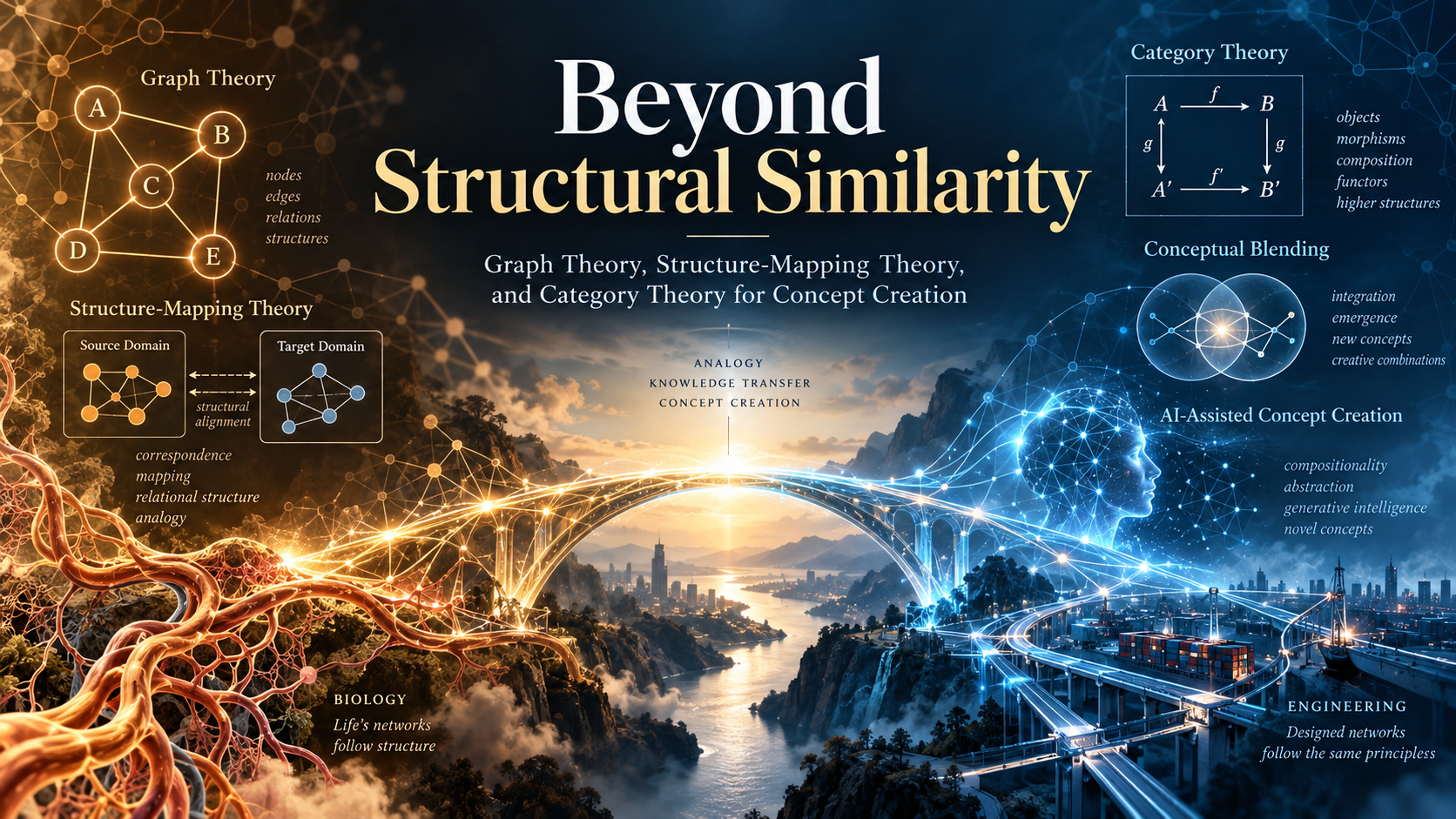
Three theoretical frameworks offer particularly interesting perspectives on this problem: Graph Theory, Structure-Mapping Theory, and Category Theory.
Graph theory provides mathematical tools for representing relationships. Structure-mapping theory explains how humans establish correspondences between relational structures in different domains. Category theory offers a more general mathematical framework for describing correspondences and transformations between mathematical structures.
Although these theories developed for different purposes, recent research has explored ways to connect them in the mathematical modeling of analogies and concept formation.
Graph Theory: Making Relationships Visible
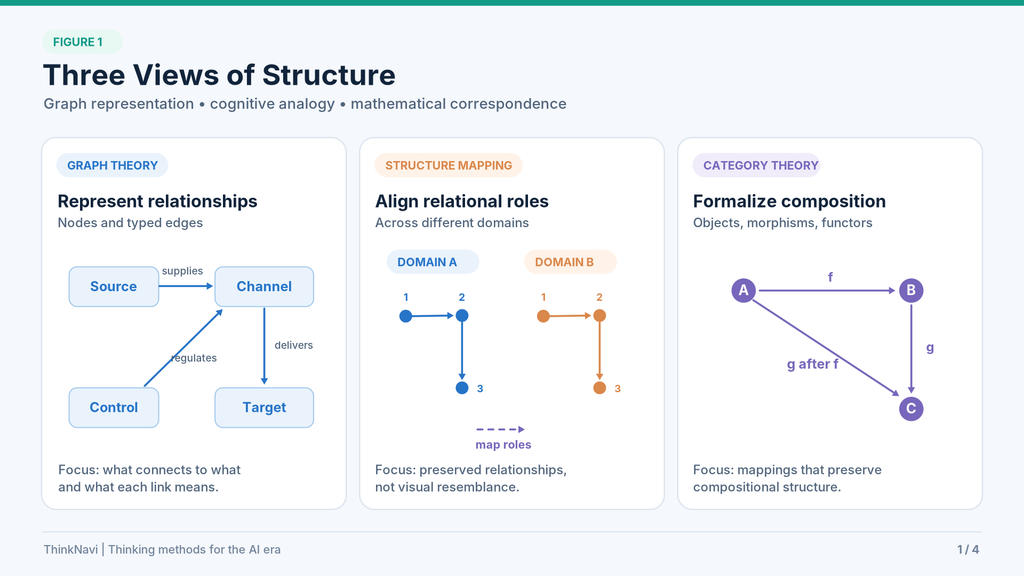
Graph theory represents entities as nodes (vertices) and relationships between them as edges.
For example, a manufacturing process can be represented as a graph in which raw materials, processing equipment, and finished products are nodes, while supply, processing, and transportation relationships are represented by edges. By assigning directions and types to these relationships, we can describe not only connectivity but also process flows and functional roles.
An important advantage of graph theory is that it allows us to analyze how entities are connected independently of their individual attributes. Two networks consisting of entirely different kinds of entities may nevertheless share similar patterns of connectivity.
However, having the same mathematical graph structure does not necessarily mean that two systems have the same meaning in the real world.
For example, the hierarchical structure of a business organization and the dependency relationships within a manufacturing process might be represented by similar graphs. Yet this does not mean that their functions are equivalent. Managerial authority and the flow of materials through manufacturing operations represent fundamentally different kinds of relationships.
To use graphs for analogy, we must consider not only connections between nodes but also the types, directions, and conditions of the relationships represented by edges.
Graph theory is therefore a powerful tool for representing and comparing structures, but it does not by itself determine which relationships are significant or which correspondences are meaningful.
Structure-Mapping Theory: Analogy Is Fundamentally Relational
In 1983, cognitive scientist Dedre Gentner proposed Structure-Mapping Theory as an explanation of the cognitive mechanisms underlying analogy.
A central idea of this theory is that analogy depends primarily on correspondences between relational structures rather than similarities in the surface attributes of individual objects.
Consider the familiar analogy between the solar system and classical models of the atom. The Sun and an atomic nucleus, or planets and electrons, have very different physical properties. Nevertheless, certain structural correspondences can be identified by focusing on relationships between a central entity and other entities associated with it.
Of course, planetary motion and electron behavior are not governed by identical physical models. This example illustrates relational correspondence, not scientific equivalence.
Structure-mapping theory emphasizes not only the matching of individual relationships but also systematic correspondences among interconnected relational structures. This is known as the Systematicity Principle.
When multiple relationships in one domain can be mapped consistently onto relationships in another, the resulting analogy may support new inferences.
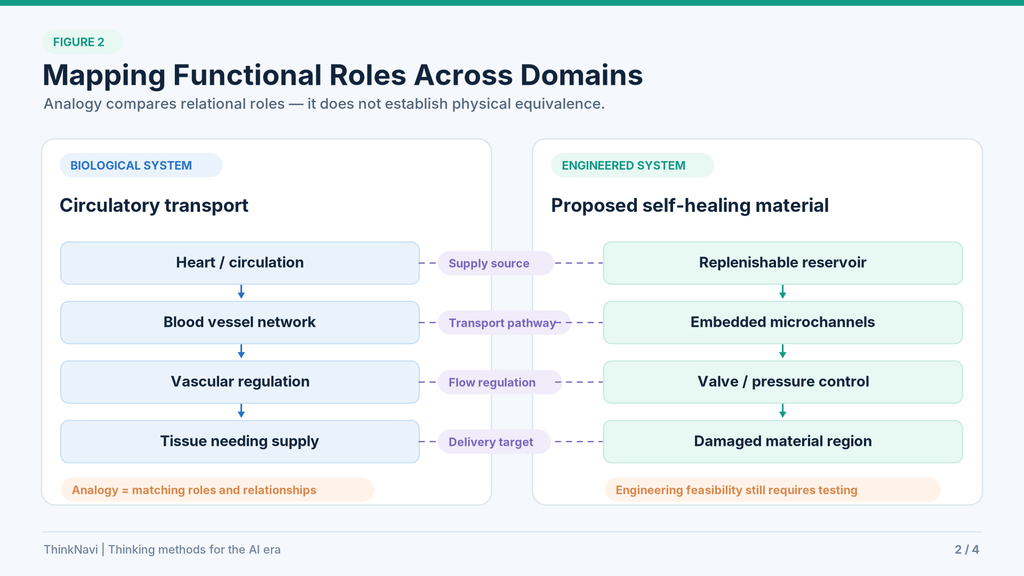
For example, suppose we understand the biological circulatory system in terms of supply sources, transportation pathways, areas of demand, and mechanisms for regulating flow. By mapping these relationships onto an artificial material-delivery system, we might identify design possibilities such as demand-responsive supply or redundant transportation pathways.
The essential point is not to imitate an existing object but to identify the relational structure underlying its operation and apply that structure to a different problem.
This perspective can support cross-domain knowledge transfer in technological development and the exploration of new business opportunities.
Category Theory: A Mathematical Framework for Structural Correspondence
Category theory was introduced in the 1940s by mathematicians Samuel Eilenberg and Saunders Mac Lane. Originally developed in connection with research in algebraic topology, it subsequently became a unifying mathematical language across many fields.
Category theory is based on two fundamental notions: objects and morphisms between objects. Morphisms can be composed, each object has an identity morphism, and composition satisfies the associative law.
At first glance, this resembles a graph consisting of nodes and edges. However, category theory incorporates the composition of morphisms as part of its fundamental structure, allowing relationships between objects to be examined in terms of their compositional properties.
For example, when a graph contains an arrow from A to B and another from B to C, graph theory allows us to consider a path from A to C. Category theory goes further by treating the composition of the corresponding morphisms as a formally defined operation.
However, when real-world causal or functional relationships are represented as morphisms, the meaning and validity of their composition must be carefully specified.
Another important concept in category theory is the functor.
A functor maps objects and morphisms from one category to another while preserving identity morphisms and composition.
This makes it possible to describe structural correspondences between different mathematical systems.
Whereas structure-mapping theory explains the cognitive processes involved in analogy, category theory provides abstract and rigorous tools for describing structure-preserving mappings.
Nevertheless, replacing structure-mapping theory with category theory would not automatically solve every problem associated with analogy.
Determining which objects and relationships should correspond, and which structures are important, still requires knowledge and semantic interpretation.
From Analogy to Conceptual Blending: Pullbacks and Pushouts
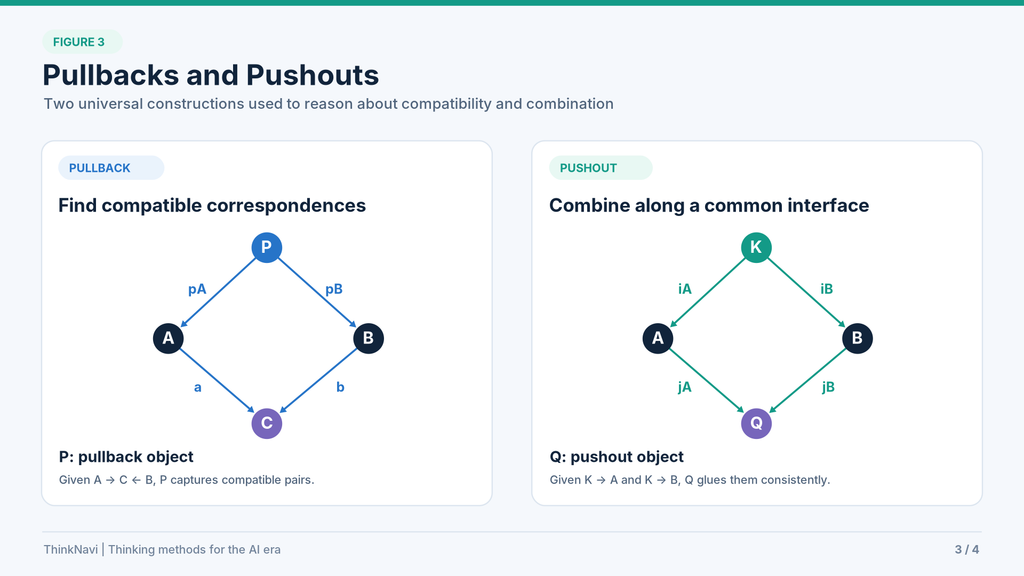
Two particularly interesting concepts for exploring the relationship between category theory and analogy are pullbacks and pushouts.
A pullback is a categorical construction that, given two morphisms pointing toward a common object, defines an object satisfying a universal property with respect to their compatibility. In research on analogy, pullback-based constructions have been used to identify correspondences that preserve specified relationships between knowledge domains.
A pushout is a construction that combines two objects along a shared structure, again characterized by a universal property. This mathematical idea has been applied to the formalization of conceptual blending.
Conceptual blending is a cognitive process in which elements and relationships from different conceptual domains are combined to form a new conceptual structure.
In 2021, Marco Schorlemmer and Enric Plaza published a unified computational model of conceptual blending based on category theory. Their research investigated a mathematical framework that could be applied across different knowledge representation systems.
In 2025, Claire Ott published a paper titled Structural Similarity: Formalizing Analogies Using Category Theory. The study represented knowledge domains as colored multigraphs and proposed methods for discovering analogical correspondences using categorical products and pullbacks, followed by conceptual blending through pushouts.
These studies suggest that discovering structural similarities and constructing new concepts through shared structures can be examined within a common mathematical framework.
However, an important distinction must be maintained.
The mathematical consistency of a blended structure does not guarantee that it represents a technologically feasible invention or a useful idea. Mathematical consistency, physical feasibility, economic viability, and social usefulness are separate questions.
Nevertheless, representing conceptual blending as explicit structural operations offers an important advantage: it becomes easier to examine which pieces of knowledge contributed to an idea and how the relationships among them produced the resulting concept.
The Potential of Structural Analogy in AI
Large language models (LLMs) can connect knowledge from different fields and generate ideas through analogy.
However, evaluating the structural validity of those analogies remains challenging. An explanation may appear convincing at first glance, even though important relationships fail to correspond when examined more carefully.
This is where structure-mapping theory and category theory may provide valuable complements to AI.
For example, an LLM could extract significant entities and relationships from two domains and represent them as graphs. A structural comparison algorithm could then identify possible correspondences and evaluate how consistently important relationships are preserved.
Such an analysis could reveal not only the relationships that match but also mismatches, contradictions, and limitations of the analogy.
A study released in October 2026, PRISM: A Category-Theoretic Framework for Measuring and Refining Multimodal Analogies, proposed using category-theoretic measures of structural correspondence to evaluate and refine visual metaphor generation.
This research addresses a specific class of problems and does not establish a general capacity for automated creative thinking. Nevertheless, it illustrates an interesting direction: evaluating analogies generated by AI through explicit relational structures and feeding the results back into the generation process.
Traditional thinking methods sought to systematize analytical procedures performed by humans. In the AI era, it may become increasingly important to develop methods for structurally evaluating the hypotheses and analogies generated during the thinking process itself.
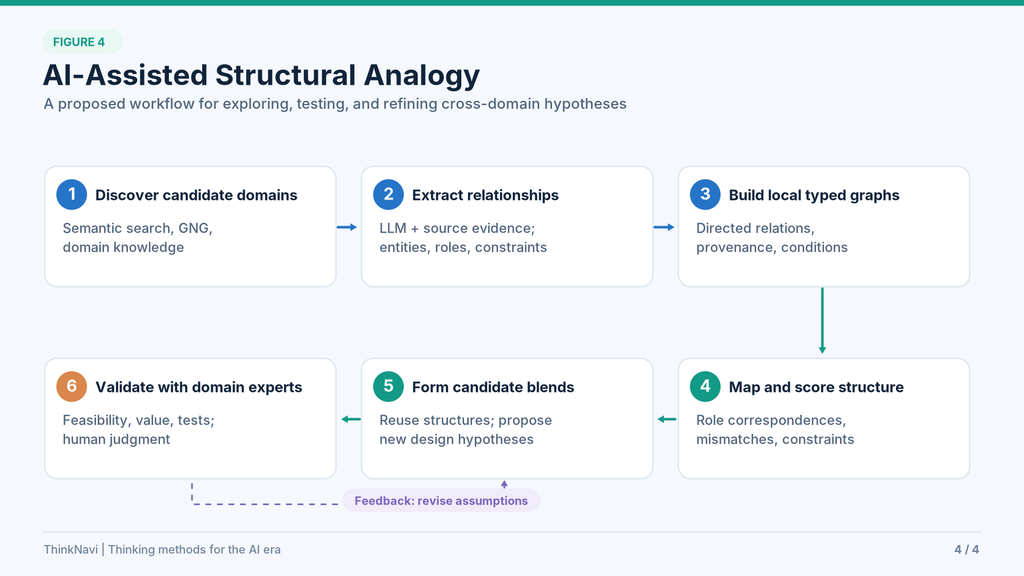
Cross-Domain Exploration and the Formation of New Technological Concepts
One area where these approaches may offer practical value is research and development involving knowledge transfer across different technological domains.
Consider the challenge of supplying healing agents to damaged areas of a self-healing material.
One established approach involves dispersing microcapsules containing healing agents throughout a material. However, this approach may have difficulty repairing repeated damage at the same location once the available healing agent has been consumed.
We could therefore investigate systems in other domains that share a functional structure: repeatedly delivering necessary substances to locations where they are needed.
Biological blood vessels, plant vascular systems, industrial logistics networks, and fluid-distribution systems all contain elements and relationships involving supply sources, transportation pathways, destinations, and flow regulation.
Rather than merely proposing a material that imitates blood vessels, we could compare the relational structures underlying these systems.
Under what conditions does supply begin? What happens if a transportation pathway is damaged? Are delivery destinations fixed or variable? Can the supply source be replenished?
Comparing such relationships may help distinguish mechanisms that could potentially be adapted to artificial materials from those that cannot.
Furthermore, combining different mechanisms from several domains may lead to design hypotheses that could not be obtained by imitating a single biological or technological system.
At this stage, the challenge extends beyond mapping an existing relational structure onto another domain. It involves blending different structures to form a new technological concept.
Category theory may provide one possible theoretical foundation for formalizing this process.
Toward the Integration of Thinking Methods
The potential applications of category theory extend beyond cross-domain analogy and conceptual blending.
In 2012, David I. Spivak and Robert E. Kent proposed Ologs (Ontology Logs) as a category-theoretic framework for knowledge representation.
Ologs allow types of entities and their relationships to be represented explicitly, while functors can describe correspondences between different knowledge structures.
This approach suggests possibilities for comparing and integrating knowledge across different disciplines while preserving meaningful distinctions between their conceptual systems.
In practical problem-solving, researchers, engineers, executives, and customers may understand the same situation through different conceptual frameworks.
A relationship considered essential by one group may be absent from another group’s analysis.
If correspondences between these structures can be made explicit, it may become possible to share knowledge through more than simply agreeing on common terminology. Different interpretations and relationships could be examined and reconciled systematically.
This direction is also relevant to thinking-support systems such as ThinkNavi.
Traditional thinking methods have their own analytical procedures and representational formats. SWOT analysis, causal analysis, argument analysis, and decision analysis may all address the same problem, yet describe it through different structures.
Instead of merely presenting the results of these analyses side by side, a more advanced system could identify relationships among them and transfer findings from one analytical framework into another.
Such integration could support thinking processes that extend across multiple methods.
However, this does not mean that sophisticated category-theoretic models must be implemented from the beginning.
Graph theory, logical constraints, and established algorithms may be sufficient for many practical applications.
The important question is what level of mathematical formalization is actually required to solve a particular problem in thinking or knowledge representation.
From Discovering Structures to Creating Concepts
Graph theory, structure-mapping theory, and category theory developed in different research traditions. Nevertheless, considering them together reveals a potentially important progression in methods of thinking.
First, we represent a domain in terms of elements and relationships. Next, we discover common relational structures across different domains. We then transfer knowledge through those correspondences and, where appropriate, combine different structures to form new concepts and hypotheses.
This progression suggests a direction of thinking that extends beyond organizing existing knowledge toward exploring previously unrecognized possibilities.
However, structural similarity is only a starting point for creative insight.
Mathematical structures alone cannot determine which relationships deserve attention, what meanings should be assigned to them, or whether a newly generated concept has practical value.
AI can assist in exploring large bodies of knowledge, extracting relationships, and evaluating structural correspondences. Yet determining whether the results represent meaningful discoveries still requires domain understanding and critical examination.
From structuring what we already know, to discovering new relationships between different structures, and ultimately to imagining concepts that do not yet exist.
Supporting this progression may become one of the important possibilities for thinking methods in the age of artificial intelligence.
References and Further Reading
- Gentner, D. (1983). Structure-Mapping: A Theoretical Framework for Analogy. Cognitive Science, 7(2), 155–170.
- Spivak, D. I., & Kent, R. E. (2012). Ologs: A Categorical Framework for Knowledge Representation. PLOS ONE, 7(1), e24274.
- Schorlemmer, M., & Plaza, E. (2021). A Uniform Model of Computational Conceptual Blending. Cognitive Systems Research, 65, 118–137.
- Ott, C. (2025). Structural Similarity: Formalizing Analogies Using Category Theory. Logics, 3(4), 12.
- Ott, C., & Jäkel, F. (2025). Types of Relations: Defining Analogies with Category Theory. arXiv preprint.
- Zeisler, M., et al. (2026). PRISM: A Category-Theoretic Framework for Measuring and Refining Multimodal Analogies. arXiv preprint.
