

We Understand the World Through Signs
In everyday life, we use signs to understand the world around us. Words, numbers, diagrams, colors, and logos function as signs, but so do product designs, clothing, architecture, and corporate brands. All of these can communicate meanings beyond their immediate physical properties.
Consider the word “luxury.” It does not simply mean that something is expensive. It also evokes associations with quality, rarity, tradition, prestige, and social status. When we perceive a product as luxurious, we are recognizing certain characteristics of its appearance and materials while simultaneously interpreting meanings acquired through our social and cultural experiences.
However, the signs we use do not necessarily represent the essential nature of what they signify. By classifying and interpreting the world through signs, we focus on certain aspects of reality while potentially overlooking others.
This problem lies at the heart of semiotics, a field that developed significantly during the twentieth century. Examining semiotics alongside the distinction between symbolic and pattern-based approaches in cognitive science and artificial intelligence offers an interesting perspective on how humans think.
Saussure and Semiotics: Meaning Emerges Through Relationships
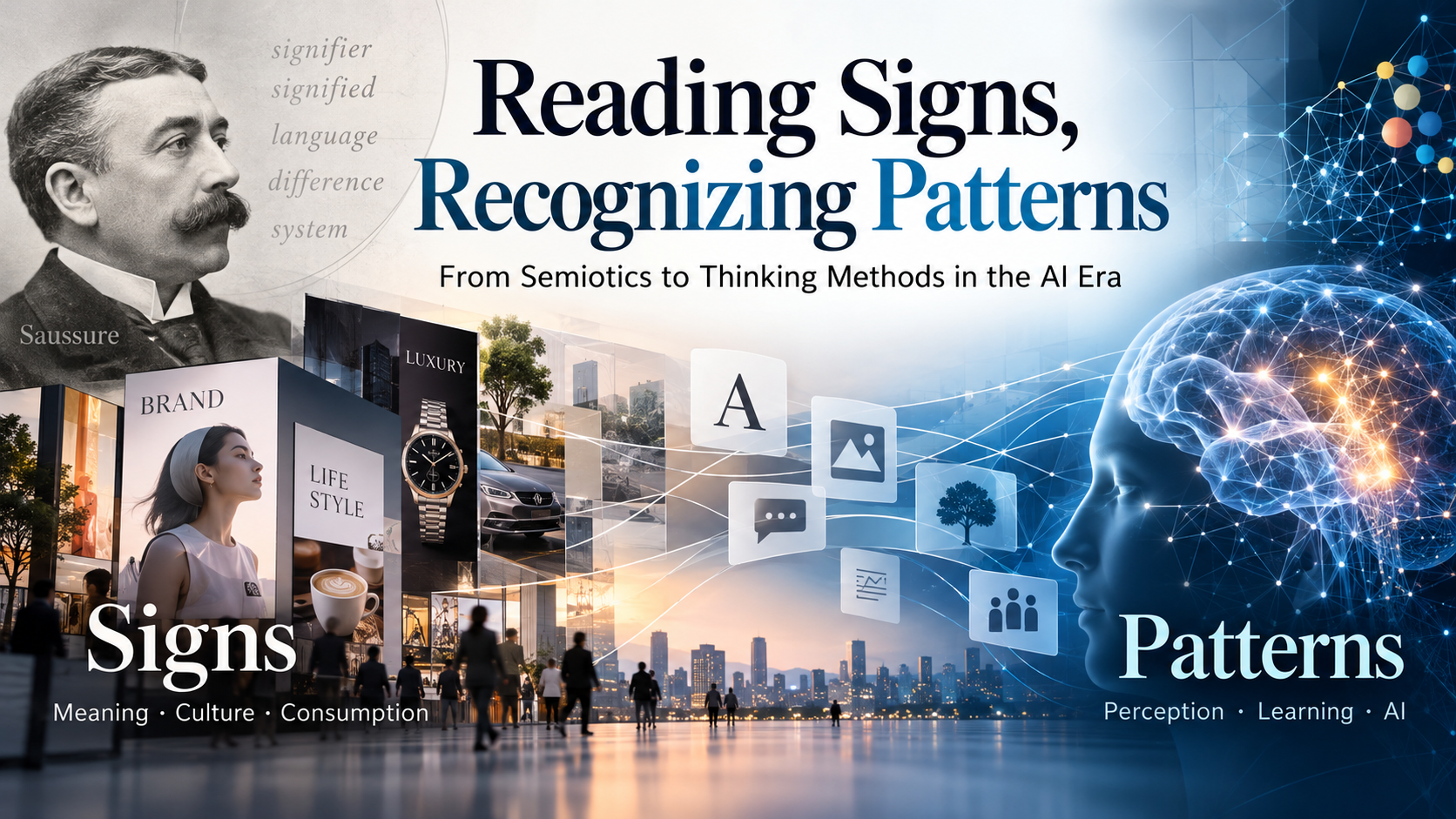
One of the foundations of modern semiotics is the work of the linguist Ferdinand de Saussure. He described the linguistic sign as a relationship between the signifier, the form of a sign, and the signified, the concept associated with that form.
For example, the spoken or written word “tree” is a signifier, while the concept of a tree is the signified. The connection between the word and the concept is not generally determined by nature but established through conventions within a linguistic community.
An important insight of Saussure’s theory was that linguistic values are defined through differences and relationships within a system. The meaning of “luxury,” for instance, becomes clearer through its relationships with concepts such as “ordinary,” “inexpensive,” and “mass-market.”
This perspective became an important foundation for structuralism, which emphasizes the relationships and systems underlying individual elements. Semiotics subsequently expanded beyond language into the analysis of culture, advertising, fashion, visual communication, and other phenomena.
Meanwhile, the American philosopher Charles Sanders Peirce independently developed another influential approach to semiotics. Peirce emphasized a triadic relationship involving the sign, its object, and its interpretant. He also distinguished among icons, indexes, and symbols. Icons signify through resemblance, indexes through an actual connection with their objects, and symbols through conventions or rules.
In Peirce’s approach, meaning is not merely a fixed correspondence between a sign and an object. It involves processes of interpretation.
This provides an important perspective for understanding what it means to recognize and interpret signs.
Sign Consumption: What Do Products Really Mean?
One particularly interesting application of semiotics is the analysis of consumer society.
In Mythologies, Roland Barthes examined everyday cultural phenomena as systems of signs. He explored how advertising, products, entertainment, and other familiar objects communicate social values and ideologies beyond their immediate functions.
Jean Baudrillard subsequently examined the meanings of commodities in consumer society, emphasizing the importance of sign value, which cannot be explained solely by use value or exchange value.
A car provides transportation, and a wristwatch indicates the time. Yet particular brands and designs can also signify prestige, success, sophistication, or a desirable lifestyle. Consumers may choose products not only for their practical functions but also for the meanings associated with owning them.
The theory of sign consumption attracted considerable attention in Japan during the 1980s. Marketing and advertising increasingly emphasized imagery, lifestyles, and the symbolic meanings of brands alongside product functionality and quality.
However, two different approaches need to be distinguished.
The first seeks to understand the meanings consumers associate with products and brands. The second seeks to influence consumer desires and choices by manipulating those meanings.
Semiotics was not originally developed as a theory for manipulating consumers. It is a field concerned with understanding how meaning is produced, communicated, and interpreted.
Semiotic analysis can therefore be used to improve marketing effectiveness, but it can also help people critically examine the assumptions, conventions, and values embedded in consumer culture.
Understanding how signs influence perception may provide a means of questioning their influence rather than simply reinforcing it.
Symbolic Thinking and Pattern-Based Recognition
The concept of symbols also plays an important role in cognitive science and artificial intelligence.
In classical symbolic AI, knowledge is explicitly represented through symbols and rules. Reasoning involves manipulating these representations according to defined procedures.
For example, if a system is given the statements “All mammals are vertebrates” and “Whales are mammals,” it can infer that “Whales are vertebrates” by applying logical rules.
Connectionism, by contrast, seeks to explain cognition through interactions among many interconnected processing units. Artificial neural networks learn patterns and regularities from data and develop distributed internal representations.
For example, a neural network trained on large numbers of images can learn features useful for recognizing objects without relying entirely on explicitly programmed recognition rules.
The relationship between symbolic approaches and connectionism has been debated extensively in cognitive science.
However, an important distinction must be made: the signs studied in cultural semiotics are not identical to the formal symbols manipulated by classical AI systems.
Semiotics investigates how signs acquire meaning and how they are interpreted within social and cultural contexts. Symbolic AI investigates how explicit representations can be manipulated to perform reasoning and information processing.
Nevertheless, these two fields share an underlying concern with the relationship between representation and understanding.
When humans recognize an object, they do not necessarily begin with an explicit word or concept. We may first perceive similarities or regularities in shapes, colors, textures, movements, or other characteristics.
We can then describe what we recognize using concepts such as “luxurious,” “safe,” or “innovative.”
Conversely, prior knowledge can influence perception. When an object is presented as belonging to a luxury brand, that information may change how we perceive and evaluate it.
Pattern recognition can contribute to symbolic interpretation, while symbolic knowledge and expectations can influence the recognition of patterns.
The two processes are not entirely independent.
Rather than assuming that human cognition consists of two strictly separate mechanisms, it is more useful to examine how explicit, linguistically structured knowledge interacts with the recognition of features and regularities that may not yet have been expressed in words.
Where Does the Meaning of a Symbol Come From?
This question is closely related to the symbol grounding problem in artificial intelligence.
In 1990, cognitive scientist Stevan Harnad raised the question of how the meanings of symbols in a formal symbol-processing system could be connected to the real world rather than being defined exclusively through other symbols.
A computer may manipulate the symbol “apple” according to formal rules. However, that ability alone does not establish that the system understands the appearance, texture, taste, or other properties of an apple.
If the meaning of one symbol is explained only through other symbols, each of which requires further symbolic explanations, the system risks remaining within a closed circle of definitions.
How can symbols become connected to objects, perception, and experience?
This is the central issue of the symbol grounding problem.
Meaning, however, does not arise solely from individual sensory experiences. Language and social conventions develop and change through communication among people.
Research on symbol emergence examines how shared symbolic systems and meanings can develop through interactions among perception, action, learning, and communication.
Large language models (LLMs) have introduced new dimensions to these questions.
LLMs learn statistical regularities and relationships from enormous amounts of linguistic data, enabling them to generate coherent text and perform various language-related tasks.
However, the ability to manipulate language successfully and the question of how language is connected to understanding the world are not identical problems.
Modern AI systems also cannot be neatly divided into purely symbolic and purely pattern-based approaches. Neural networks can learn distributed representations while performing tasks involving language, mathematical reasoning, and logical relationships. Research also increasingly combines vision, language, and action.
The relationship between symbols and patterns has not been resolved by advances in AI. Instead, these advances have created new ways of investigating it.
Rethinking Semiotic Marketing as a Thinking Method
When semiotics is applied to marketing, the analysis often focuses on interpreting meanings embedded in products, advertisements, and brands.
However, semiotic interpretation can depend heavily on an analyst’s knowledge, experience, and perspective.
For example, an analyst may identify meanings such as “freedom,” “individuality,” or “innovation” in a particular advertisement. Yet this does not necessarily mean that consumers perceive those meanings in the same way.
Different consumers may interpret the same product or advertisement quite differently.
This suggests an opportunity to combine semiotic interpretation with pattern analysis.
Consider a study in which consumers provide open-ended descriptions of several competing brands.
Text analysis can identify recurring expressions, concepts, and evaluations. Pattern analysis can then explore similarities, differences, and clusters within those responses.
The resulting structures may reveal how consumers collectively perceive the brands, including associations that were not anticipated by the companies themselves.
These findings can then be compared with the meanings companies attempt to communicate through advertising, product design, and brand strategy.
For example, a company may emphasize environmental responsibility, while consumers associate its products more strongly with high prices, inconvenience, or technological performance.
Such discrepancies can provide valuable opportunities to reconsider brand positioning.
Semiotics also includes methods for systematically analyzing meaning. The semiotic square, associated with Algirdas Julien Greimas, examines relationships of opposition, contradiction, and implication among semantic categories.
Combining approaches such as the semiotic square with semantic differential scales, correspondence analysis, multidimensional scaling, text mining, and concept mapping may enable qualitative interpretation and quantitative pattern analysis to complement one another.
However, mathematical similarity does not automatically imply similarity in cultural meaning. A statistical cluster is not necessarily a meaningful consumer segment.
Patterns discovered through computational analysis still require interpretation and, where appropriate, empirical validation.
The objective is not merely to classify consumers using familiar marketing categories.
It is also to discover structures of meaning in consumer perceptions that companies have not yet recognized.
Thinking With Symbols and Thinking Beyond Them
The relationship between symbols and patterns is relevant not only to marketing but also to problem-solving, strategic planning, and decision-making.
Consider SWOT analysis.
The method organizes business conditions into four categories: strengths, weaknesses, opportunities, and threats.
This classification makes complex situations easier to examine and communicate. However, it may also encourage analysts to search for information that fits the predefined categories.
A capability considered a strength in one environment may become a weakness in another. A company not previously regarded as a competitor may become an important competitive threat following changes in technology or market structure.
We use words and concepts to understand reality, but these concepts can also constrain the boundaries of our thinking.
Pattern-based exploration offers a different approach.
Instead of beginning exclusively with predefined categories, we can examine similarities, differences, and relationships within data and seek structures that were not anticipated in advance.
These structures can then become the basis for forming new concepts.
For example, rather than segmenting customers solely according to age, income, or other familiar attributes, we might identify new groups through similarities in their behaviors and expressed needs.
Similarly, instead of searching for technologies only within established industrial classifications, we might explore similarities in functions, mechanisms, or physical effects across different technical domains.
In such processes, thinking moves back and forth between using existing symbols to classify the world and discovering patterns that may require new classifications or concepts.
Pattern analysis itself is not free from assumptions. The selection of data, features, similarity measures, and analytical models influences what can be discovered.
Removing explicit symbolic categories does not automatically produce an objective or unbiased understanding of reality.
What matters is recognizing the strengths and limitations of both approaches and using them to examine one another.
Toward Thinking Methods in the AI Era
ThinkNavi aims to support established methods for logical thinking, problem-solving, strategic planning, and decision-making through computers and artificial intelligence.
Semiotics offers an interesting perspective on how such support might evolve.
Many thinking methods work by transforming complex situations into explicit representations. They identify elements, establish categories, describe relationships, and apply defined procedures.
This externalization of thought makes reasoning easier to examine, communicate, and critically evaluate.
However, representing a problem explicitly does not guarantee that the representation adequately captures the problem itself.
Words and categories introduced for analytical convenience can gradually come to be treated as if they were inherent properties of reality.
AI creates opportunities not only to support analysis using existing categories but also to explore information that does not fit those categories, reconsider classifications from different perspectives, and propose new concepts.
It may also become possible to examine the meanings of concepts used in an analysis, identify competing interpretations, and compare the conclusions produced by different thinking methods.
In this context, semiotics contributes more than a specific analytical algorithm.
It provides a perspective for critically examining the concepts and representations through which we understand the world.
Humans depend on signs to communicate complex knowledge and conduct abstract reasoning. Yet whenever we interpret reality through signs, we are also adopting particular perspectives and classifications.
We can use symbols to make thinking explicit, patterns to discover relationships overlooked by existing classifications, and the resulting insights to form new concepts.
Supporting this cycle may become an important direction for thinking methods in the AI era.
Since Saussure, semiotics has examined how meaning is established through signs and relationships. AI research, meanwhile, raises questions about how systems that learn patterns from data can represent, manipulate, and potentially develop meaningful concepts.
Although these fields differ in their objectives and methodologies, both confront fundamental questions about representation, meaning, and understanding.
We use signs to understand the world. But we should not allow the signs we create to understand the world to become the boundaries of our thinking.
Recognizing this distinction may significantly change how we use thinking methods.
References and Further Reading
- Ferdinand de Saussure (1916), Course in General Linguistics.
- Roland Barthes (1957), Mythologies.
- Stanford Encyclopedia of Philosophy — Jean Baudrillard
- Stanford Encyclopedia of Philosophy — Peirce’s Theory of Signs
- Stanford Encyclopedia of Philosophy — Connectionism
- Stevan Harnad (1990), The Symbol Grounding Problem, Physica D, 42, 335–346.
- Tadahiro Taniguchi et al. (2018), Symbol Emergence in Cognitive Developmental Systems: A Survey.
- Paola Signori & Daniel J. Flint (2020), Revealing the Unique Blend of Meanings in Corporate Identity: An Application of the Semiotic Square, Journal of Marketing Theory and Practice.