
Thinking Methods Have a History
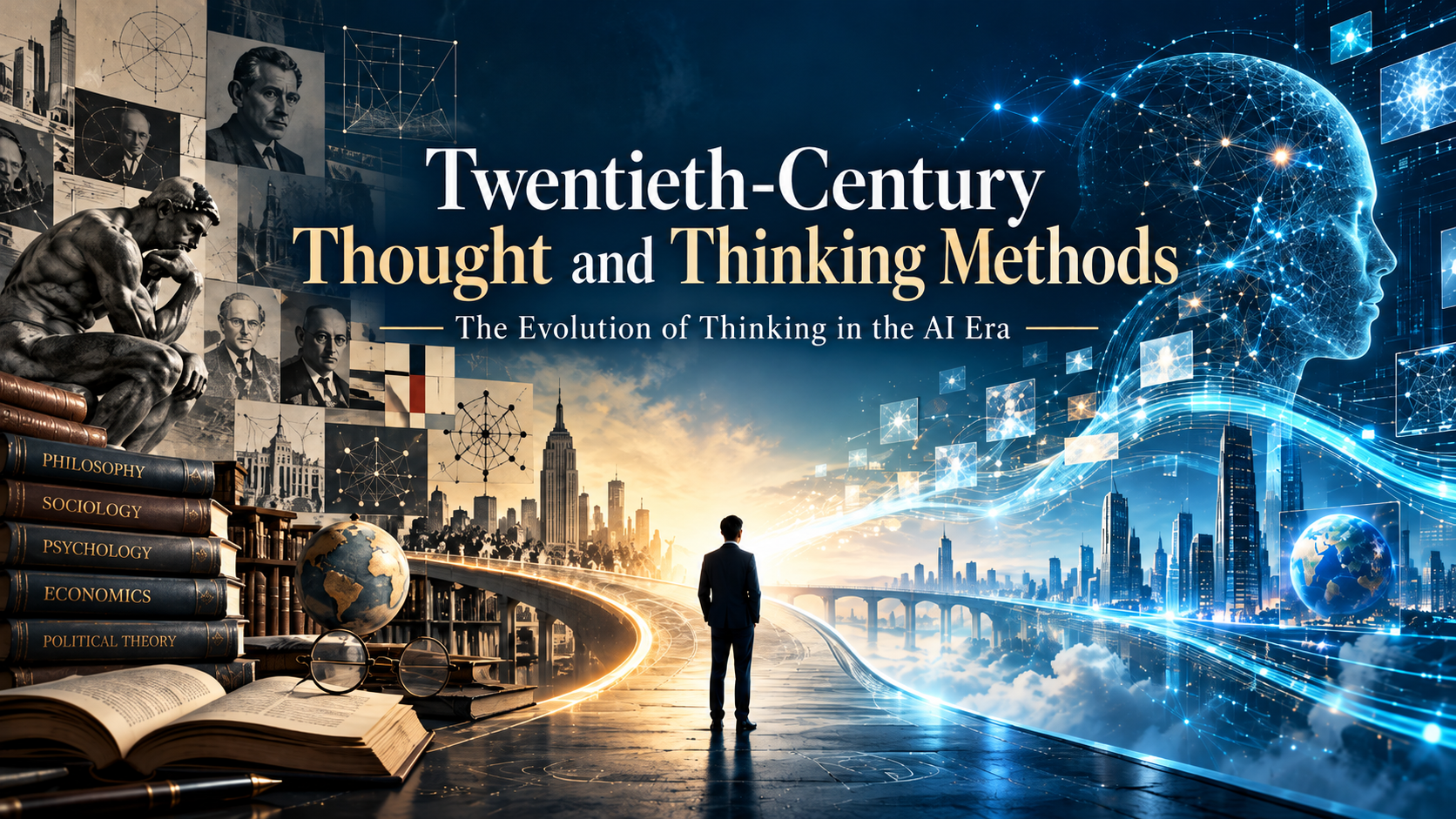
Throughout history, people have sought ways to understand the world, make rational judgments, and generate new ideas. Logic and dialectics have roots in antiquity, but many of the thinking methods we use today for problem-solving, strategic planning, and decision-making were systematized and developed during the twentieth century.
The twentieth century witnessed not only rapid advances in science, technology, and industrial society but also major intellectual movements that challenged our understanding of knowledge, society, human experience, and existence. Logical positivism, structuralism, phenomenology, existentialism, pragmatism, systems theory, and critical theory each offered different perspectives on how people think and understand the world.
Meanwhile, disciplines such as management science, psychology, cognitive science, operations research, and decision science developed practical approaches for supporting thought through explicit procedures and rules. SWOT analysis, morphological analysis, scenario planning, the Analytic Hierarchy Process (AHP), and systems thinking are among the methods that emerged or developed within these traditions.
These methods were not necessarily derived directly from particular philosophical movements. Nevertheless, examining what each method emphasizes and what it treats as an object of analysis reveals intriguing connections with the intellectual currents of the twentieth century.
Understanding the World Through Structures
One of the influential intellectual movements of the twentieth century was structuralism. Drawing significantly on the linguistics of Ferdinand de Saussure and later developed in fields such as anthropology by Claude Lévi-Strauss, structuralism emphasized understanding phenomena through the systems of relationships that give their elements meaning, rather than examining each element in isolation.
For example, the meaning of a word does not exist independently of other words. It emerges through differences and relationships within a linguistic system. Similarly, structuralist approaches to culture seek to identify underlying patterns and relationships that organize seemingly diverse practices and beliefs.
This perspective has much in common with various thinking methods. SWOT analysis organizes business conditions into internal and external factors, strengths and weaknesses, and opportunities and threats. Morphological analysis decomposes problems into dimensions and explores combinations of their possible configurations. Systems thinking examines causal relationships and feedback loops. Structure-mapping theory identifies relational correspondences between otherwise different domains.
These approaches are not identical to philosophical structuralism. Nevertheless, they share an intellectual orientation: making complex phenomena more understandable by identifying elements, relationships, and underlying structures.
Structuring thought offers substantial practical benefits. It helps clarify vague perceptions, reveal previously unnoticed relationships, and make reasoning easier to communicate and examine. When analytical procedures are made explicit, they can also be supported by computers.
However, structuring thought has limitations. The framework used to understand a problem influences what becomes visible and what remains overlooked.
Between Rationality and Individuality
Alongside approaches emphasizing structures and systems, twentieth-century philosophy also developed traditions that placed greater emphasis on individual experience, freedom, choice, and responsibility.
Phenomenology investigated how people experience and give meaning to the world. Existentialism emphasized the individual’s responsibility for choosing how to live and acting within concrete circumstances. While structuralism often focused on systems extending beyond individual subjects, existentialism placed greater emphasis on human agency and lived experience.
This contrast offers a useful perspective on management strategy and decision-making methods.
Consider product portfolio management (PPM), which became widely used during the 1970s. In a familiar form of portfolio analysis, businesses are classified according to market growth and relative market share to support resource allocation decisions. This provides a useful framework for comparing multiple businesses using common criteria.
However, every company has its own history. The convictions of its founder, technologies developed over decades, its sense of social mission, and the pride of its employees cannot be fully represented by market growth and market share.
A business classified as a candidate for divestment on economic grounds may also represent an essential part of a company’s technological foundation or identity. Conversely, preserving a founder’s philosophy may sometimes prevent an organization from adapting to changing circumstances.
The important question is not whether economic rationality or organizational values should always prevail. It is how to make their relationship explicit and enable decisions based on a conscious understanding of competing priorities and trade-offs.
Methods addressing such concerns also emerged during the twentieth century. Soft Systems Methodology, developed by Peter Checkland and colleagues, recognizes that people may understand the same problematic situation differently depending on their worldviews. Value-Focused Thinking, proposed by Ralph Keeney, begins by clarifying what decision-makers fundamentally seek to achieve, rather than merely comparing predefined alternatives. Those values can then become a source for generating new alternatives.
These developments suggest that thinking methods need not remain confined to rationalization and optimization. They can also help people examine their values and exercise meaningful choice.
Where Is Twenty-First-Century Thought Heading?
There is no widely accepted answer to which intellectual movement will define the twenty-first century. Nevertheless, contemporary challenges suggest several emerging directions.
First, understanding individual elements or fixed structures is no longer sufficient. Increasing attention must be paid to interdependence, complexity, and change itself. Business activities, technologies, economies, societies, and natural environments are deeply interconnected. Changing one component can produce unexpected consequences elsewhere. Complexity science, network science, and relational approaches to philosophy provide different perspectives for understanding such conditions.
Second, recognizing multiple values and worldviews is becoming increasingly important. Economic efficiency is only one consideration among others, including environmental impacts, social justice, cultural diversity, and individual or organizational autonomy. Many important decisions involve competing objectives that cannot be reduced to a single universally accepted measure.
Third, attention is shifting from predicting the future toward exploring multiple possible futures and actively shaping desirable ones. Scenario planning and strategic foresight have histories extending back into the twentieth century, but increasingly uncertain environments make it particularly important to revisit existing assumptions, forecasts, and plans.
These directions did not suddenly appear in the twenty-first century. Rather, intellectual concerns developed over many decades are gaining renewed significance under changing technological and social conditions.
Artificial intelligence may become a particularly important force in accelerating this transformation.
How AI Changes Thinking Methods
Traditional thinking methods generally assumed that humans would perform analytical procedures themselves. Computers mainly supported calculation, information organization, modeling, and visualization.
The emergence of large language models (LLMs) is changing this relationship. AI can interpret texts, extract arguments, generate hypotheses and counterarguments, and establish connections between knowledge from different fields. Activities that previously depended heavily on human interpretation and reasoning can now receive various forms of AI assistance.
However, the central question is not simply how much of an existing thinking method can be automated.
For example, AI can produce a structured SWOT analysis in a short time. But are the categories used in the analysis appropriate? Are the organization’s objectives themselves reasonable? Is solving the stated problem actually worthwhile? Would a different problem formulation lead to more meaningful opportunities?
Without addressing such questions, AI risks becoming a mechanism for reproducing existing patterns of thought at greater speed.
At the same time, AI offers opportunities to reconsider problems from different perspectives, identify implicit assumptions, and propose alternatives that conventional analysis might overlook. It becomes possible to combine structured analysis within established frameworks with critical examination of those frameworks themselves.
Nevertheless, alternative perspectives and hypotheses generated by AI are not necessarily correct. AI systems have limitations, including biases inherited from training data and errors in reasoning. Human verification and judgment remain essential.
Furthermore, choosing among alternatives involves more than factual analysis. It also requires value judgments. Expanding the range of possibilities through AI assistance is fundamentally different from allowing AI to determine what people or organizations ought to value.
Rethinking the Meaning of Thinking Support
One of the major achievements of twentieth-century thinking methods was demonstrating that human thought could be supported through explicit procedures and rules. Rather than relying exclusively on intuition or experience, people could decompose problems, examine relationships, evaluate hypotheses, and clarify the grounds for their judgments.
These achievements remain valuable in the twenty-first century.
However, even the most sophisticated analytical method operates within assumptions, categories, and evaluation criteria. Effective use of thinking methods therefore requires the ability to examine the methods themselves, switch perspectives when necessary, and combine different approaches.
ThinkNavi aims to support a wide range of established thinking methods through computers and artificial intelligence. Its potential development extends beyond improving the efficiency of individual analytical tasks toward supporting broader processes of problem discovery, assumption examination, perspective shifting, alternative generation, and value-based decision-making.
The relationships between structure and agency, objectivity and subjectivity, rationality and values, and knowledge and action were central concerns of twentieth-century philosophy. They remain highly relevant in the age of AI.
Artificial intelligence enables us to process more information and perform more complex analyses than ever before. Yet greater information-processing capacity does not automatically lead to better thinking.
The challenge is not only to examine what we know, but also to recognize what we do not know. Not only to determine what is correct, but also to consider what is worth pursuing. Not only to solve a given problem, but also to question which problems deserve our attention in the first place.
Developing thinking methods that address these questions may be one of the defining intellectual challenges of the twenty-first century.
References and Further Reading
- Stanford Encyclopedia of Philosophy — Existentialism
- Stanford Encyclopedia of Philosophy — Pragmatism
- Stanford Encyclopedia of Philosophy — Critical Theory
- Peter Checkland — Soft Systems Methodology: A Thirty Year Retrospective
- Ralph L. Keeney — Value-Focused Thinking: Identifying Decision Opportunities and Creating Alternatives
- OECD / World Economic Forum (2025) — AI in Strategic Foresight: Reshaping Anticipatory Governance