

Brainstorming is one of the most widely known techniques for generating new ideas. It was developed and promoted by advertising executive Alex F. Osborn and became widely known through his 1953 book Applied Imagination. Today, brainstorming is used in business meetings, product development, education, workshops, and many other settings.
The central idea behind brainstorming is simple. When people try to generate good ideas, they often simultaneously worry about whether those ideas are realistic, appropriate, or likely to be criticized. This can restrict creative thinking before it has had a chance to develop. Brainstorming attempts to overcome this problem by separating idea generation from evaluation, encouraging participants to produce as many ideas as possible before judging their quality.
However, brainstorming is not a universal solution to creative problems. Depending on how it is conducted, discussions may be dominated by outspoken participants, participants may conform to group expectations, or the session may produce little more than conventional ideas. Understanding the method therefore requires examining not only its basic rules but also its limitations and possible improvements.
What Is Brainstorming Intended to Achieve?
Brainstorming is not primarily a method for selecting the best solution. Its purpose is to generate a wide range of candidate ideas, explore different perspectives, and provide material for subsequent analysis and evaluation.
For example, a team might use brainstorming to explore new customer services, identify opportunities to improve internal operations, or develop possible research themes.
If participants immediately focus on feasibility, cost, or profitability, they may limit their ideas to familiar solutions. Brainstorming creates a separate stage in which possibilities can be explored before these constraints are applied.
In this sense, brainstorming is a method for expanding the space of possible solutions rather than making a final decision. Evaluation and selection require additional steps or methods.
The Four Basic Rules of Brainstorming
Classical brainstorming is commonly described through four principles.
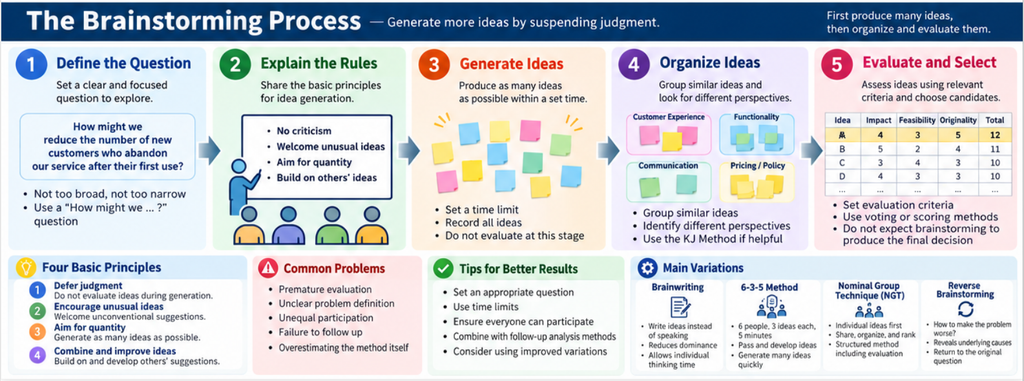
1. Defer judgment. Criticism and evaluation should be postponed during idea generation. Comments such as “That will never work” or “We have already tried that” can discourage participants from proposing unconventional ideas.
2. Encourage unusual ideas. Unexpected, unconventional, or seemingly impractical ideas are welcome. Even if they cannot be implemented directly, they may stimulate useful alternatives.
3. Aim for quantity. Participants are encouraged to generate many ideas rather than concentrating immediately on a small number of high-quality proposals. A larger pool of ideas may increase the chances of discovering promising possibilities.
4. Combine and improve ideas. Participants can build on suggestions made by others, combine different ideas, or develop them in new directions.
These principles appear straightforward, but they can be difficult to maintain in practice. In particular, suspending criticism is not merely a matter of creating a friendly atmosphere. It is a deliberate attempt to separate idea generation from evaluation.
The Basic Brainstorming Process
Although brainstorming can be conducted in different ways, a typical session follows five stages.
1. Define the Problem or Theme
Begin by identifying the question to be explored. If the theme is too broad, ideas may become scattered and superficial. If it is too narrow, participants may have little opportunity to discover alternatives.
For example, “How can we improve our company?” is too general, while “Should we change the color of this button?” may be too restrictive.
A more productive question might be: “How can we reduce the number of new customers who abandon our service after their first use?”
Questions beginning with “How might we…?” can encourage exploration. However, if the underlying problem is poorly understood, it may be better to investigate and redefine the problem before starting brainstorming.
2. Explain the Rules
Before generating ideas, remind participants that criticism should be postponed, quantity is encouraged, and building on others’ suggestions is welcome.
A facilitator should help maintain these conditions and prevent the session from becoming an ordinary discussion in which ideas are evaluated as soon as they appear.
3. Generate Ideas
Set a time limit and invite participants to contribute ideas. Suggestions may be spoken aloud, written on sticky notes, or entered into a shared digital workspace.
Record the ideas without immediately categorizing or evaluating them. Similar or overlapping suggestions can be retained at this stage.
The priority is to maintain the flow of ideas rather than produce an organized result.
4. Organize the Ideas
After idea generation, review the collected suggestions. Similar ideas can be grouped, different perspectives identified, and possible combinations explored.
Methods such as affinity diagramming or the KJ Method may be useful at this stage.
The purpose is not simply to eliminate duplicates but to understand the range of possibilities and identify promising directions for further investigation.
5. Evaluate and Select
Finally, assess ideas against relevant criteria such as feasibility, expected benefits, cost, originality, and strategic importance.
Depending on the problem, evaluation may involve voting, scoring, decision matrices, the Analytic Hierarchy Process (AHP), or other decision-making methods.
Brainstorming should not be expected to perform every stage of problem-solving. Generating alternatives and deciding among them are different activities.
Common Problems in Brainstorming Sessions
Brainstorming is widely practiced, but several recurring problems can reduce its effectiveness.
Premature evaluation. When participants begin criticizing suggestions immediately, others may become reluctant to propose unusual ideas. The session gradually turns into an ordinary meeting.
Unclear problem definition. If participants do not understand what they are trying to solve, the discussion may produce general observations rather than useful possibilities.
Unequal participation. Outspoken individuals may dominate the discussion, while quieter participants or those in less powerful organizational positions contribute relatively little.
Failure to follow up. Teams may generate dozens of sticky notes and consider the session successful without organizing, evaluating, or testing the ideas. In such cases, brainstorming becomes an event rather than a productive analytical activity.
Overestimating the method itself. Brainstorming does not automatically create original ideas. Results depend on participants’ knowledge, the definition of the problem, the quality of facilitation, and subsequent evaluation.
Variations and Improvements
Several techniques have been developed to address limitations of conventional group brainstorming.
Brainwriting replaces oral contributions with written suggestions. Participants can develop ideas independently before sharing them, reducing the effects of speaking order and social pressure.
The 6-3-5 Method is a structured form of brainwriting. Traditionally, six participants each write three ideas within five minutes, then pass their sheets to another participant, who develops or adds ideas in the next round.
Nominal Group Technique (NGT) begins with individuals generating ideas independently, followed by structured sharing, clarification, and prioritization. It combines independent idea generation with group-based evaluation.
Reverse Brainstorming asks participants how to make a problem worse rather than how to solve it. For example, instead of asking how to improve customer retention, a team might ask, “How could we make customers abandon our service as quickly as possible?” Examining the resulting answers may reveal causes of the original problem.
Another option is to have participants generate ideas individually before bringing them together for discussion. Group interaction is not always the most productive starting point for creative work.
What Does Research Say About Brainstorming?
Despite its popularity, research has not consistently shown that conventional oral group brainstorming is more productive than individual idea generation.
Experimental studies have found that interactive brainstorming groups may generate fewer ideas than nominal groups, in which the same number of individuals work separately and their ideas are later combined.
Researchers have identified several possible explanations.
Production blocking occurs when participants must wait for others to finish speaking, interrupting their own thinking.
Evaluation apprehension occurs when people hesitate to express ideas because they fear negative judgments from others.
Social loafing occurs when some participants reduce their individual effort because responsibility is distributed across the group.
These effects do not mean that group brainstorming is always ineffective. Interaction can stimulate associations, support shared understanding, and help participants build on one another’s knowledge. However, the benefits depend on how the process is designed.
The practical implication is that brainstorming should not be treated as effective simply because it is a familiar and widely accepted technique. Its procedures should be selected and adapted according to the problem, participants, and intended results.
Brainstorming in the AI Era
Large language models (LLMs) are changing the role of brainstorming. Because AI can generate large numbers of suggestions within seconds, producing ideas in quantity is no longer a task that necessarily requires a group of people.
However, this does not make brainstorming obsolete. Instead, AI creates opportunities to redesign the process.
AI as an Idea-Generation Partner
AI can propose additional perspectives, alternatives, and variations on human-generated ideas. It can also suggest opposing approaches, explore unfamiliar industries, or reconsider a problem under different constraints.
Rather than asking AI to produce a complete list of solutions, users can employ it to extend and challenge their own thinking.
AI-Assisted Problem Framing
Before generating ideas, AI can help examine whether a question is too broad, too narrow, or based on questionable assumptions.
It can suggest alternative formulations and divide a complex problem into smaller questions.
This may be particularly valuable because an incorrectly framed problem can limit the usefulness of even a highly productive brainstorming session.
AI-Assisted Organization and Development
AI can help organize large collections of suggestions, identify related ideas, propose combinations, and extract underlying themes.
It can also highlight ideas that do not fit existing categories, potentially revealing perspectives that participants have overlooked.
However, automatically grouping ideas into familiar categories may also obscure unusual or emerging concepts. Human review remains important.
Limitations of AI-Generated Ideas
AI-generated suggestions may sound plausible while remaining conventional, impractical, or inconsistent with real-world constraints.
Moreover, producing hundreds of ideas does not necessarily produce greater originality or better decisions. Quantity alone is not a sufficient measure of creativity.
AI-assisted brainstorming is therefore most useful when idea generation, structural exploration, and critical evaluation remain distinct activities.
How ThinkNavi Approaches Brainstorming
ThinkNavi treats brainstorming as a foundational technique for idea generation, but not as a complete method of problem-solving.
It can be connected with other thinking and analytical methods, including:
- Problem Framing
- SCAMPER
- Synectics
- Rhetorical Thinking
- The KJ Method and Affinity Diagramming
- Morphological Analysis
- Decision Matrices
A possible implementation in ThinkNavi Free would provide a workspace following the sequence:
Define the Theme → Generate Ideas Individually → Share Ideas → Group and Develop → Evaluate
An LLM-powered version could extend this process with alternative perspectives, reverse brainstorming, cross-domain analogies, and assistance in organizing and developing ideas. These are potential directions for future development, not descriptions of currently available features.
The objective is not to reproduce traditional brainstorming procedures mechanically, but to combine established thinking methods with transparent analytical processes and AI assistance.
Brainstorming remains useful when its purpose is understood: to create possibilities before deciding which possibilities deserve further investigation.
Related Topics
- SCAMPER | Transforming Existing Ideas
- Synectics | Discovering Solutions Across Domains Through Analogy
- The KJ Method | Building Meaningful Structures from Fragmented Information
- Rhetorical Thinking | Change the Words, Change the Perspective
- Morphological Analysis | Explore Combinations
- Abduction | Reasoning Toward Explanations
- Critical Thinking | Examining Claims and Evidence
References and Further Reading
Brian Mullen, Craig Johnson, and Eduardo Salas, “Productivity Loss in Brainstorming Groups: A Meta-Analytic Integration,” Basic and Applied Social Psychology, 12(1), 1991, pp. 3–23.
Alex F. Osborn, Applied Imagination, Charles Scribner’s Sons, 1953.
Paul B. Paulus and Bernard A. Nijstad (eds.), Group Creativity: Innovation Through Collaboration, Oxford University Press, 2003.
Teresa M. Amabile, Creativity in Context, Westview Press, 1996.
Michael Diehl and Wolfgang Stroebe, “Productivity Loss in Brainstorming Groups: Toward the Solution of a Riddle,” Journal of Personality and Social Psychology, 53(3), 1987, pp. 497–509.