

Turn AI Research and Concept Modeling into Your New Business Tool
ThinkNavi is an AI Research and Concept Modeling Platform powered by ConceptMiner.
It helps consultants, professional service providers, web development firms, and DX / AI support providers collect relevant information, create text chunks, build concept-structure models, and explore strategic themes with AI.
ThinkNavi is not simply an AI chatbot.
It is a tool for turning scattered information into a structured conceptual model that can be explored, interpreted, and used as the basis for client-facing research, analysis, and PoC services.
*ThinkNavi operates using ConceptMiner, a new system developed by Mindware Research Institute, a long-established company in the machine learning industry that has provided SOM data mining to major companies, including Toyota Motor Corporation, for the past 25 years.
Many Companies Want to Use AI, but Do Not Know Where to Start
Many companies are interested in generative AI, RAG, AI knowledge bases, internal AI assistants, and AI-powered business systems.
However, in practice, they often face the same problems:
- They do not know which business area should be AI-enabled first.
- Their internal knowledge is scattered across documents, websites, meeting notes, and personal expertise.
- They have not clearly identified which knowledge should be turned into an AI knowledge base.
- They are unsure whether a full-scale AI system is worth developing.
- They need a small PoC before committing to a larger project.
- They need help organizing the target domain before implementation.
ThinkNavi helps address this early-stage problem.
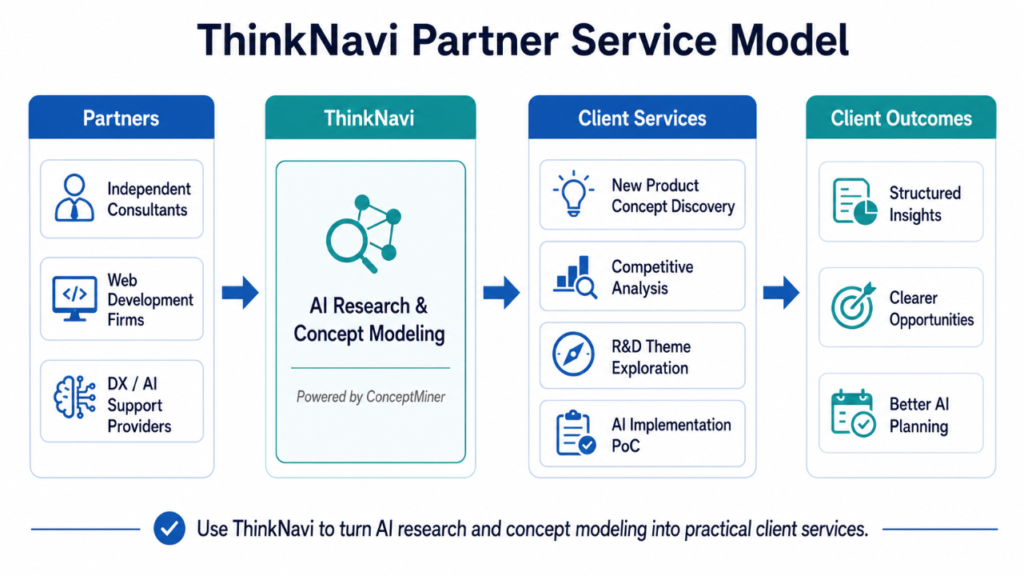
It allows consultants and knowledge professionals to provide AI research, concept modeling, and AI implementation PoC services before clients move into full-scale AI system development.
What ThinkNavi Can Do
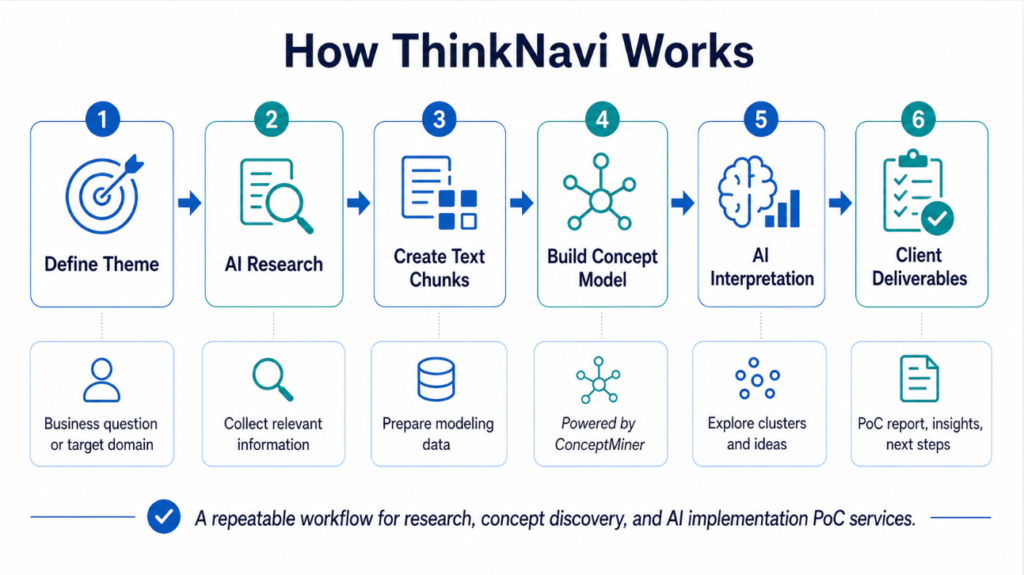
1. AI-Assisted Research
ThinkNavi can collect information related to a specified theme and prepare text chunks for concept modeling.
This can be used for themes such as:
- New product concept discovery
- Competitive analysis
- New business theme exploration
- R&D theme exploration
- Technology trend research
- Initial patent strategy research
- Market change analysis
- Customer needs hypothesis exploration
- AI implementation theme discovery
The goal is not simply to produce a list of search results.
The goal is to prepare research material that can be converted into a concept-structure model.
2. Concept Extraction from Text or PDF
ThinkNavi includes a concept extraction function that can read a text or PDF file, divide it into chunks, and create a CSV file for modeling.
This function was originally developed for creating Mindware content, but it can also be applied to business research and AI PoC projects.
Possible input materials include:
- Research reports
- Business plans
- Meeting notes
- Interview transcripts
- Customer feedback
- Product descriptions
- Technical documents
- Public PDF documents
- Industry articles
- White papers
At the current stage, this function is best suited for limited-scope data rather than large-scale enterprise knowledge base operation.
3. Concept-Structure Modeling with ConceptMiner
At the core of ThinkNavi is ConceptMiner, a technology for modeling conceptual structures from text chunks.
ConceptMiner converts text chunks into embeddings and builds a concept-structure model based on semantic proximity.
This makes it possible to explore:
- What themes exist in the collected information
- Which pieces of information are semantically close
- Which clusters of topics emerge
- Which concepts may connect different areas
- Where new opportunities or unexplored themes may exist
- Which directions should be investigated next
ThinkNavi is based on the idea of AI-assisted conceptual investigation.
It can also be understood as a modern, AI-supported approach to organizing ideas and information in a way similar to the deeper principles of the KJ Method.
4. Concept Model Viewer
The concept model can be viewed in a browser-based model viewer.
Users can examine nodes, clusters, and text chunks to understand the structure of the target domain.
For example, the model can help explore:
- Differences in competitors’ positioning
- Clusters of customer needs
- Relationships among technology themes
- Possible new product concepts
- Emerging R&D opportunities
- Gaps in existing knowledge
- Potential directions for AI implementation
The viewer allows users to move beyond linear reading and explore information as a structured knowledge space.
5. AI Chat for Model Interpretation
ThinkNavi also supports AI-based interpretation of the created model.
Users can ask questions such as:
- What does this cluster represent?
- What are the key themes in this model?
- What new product concepts could emerge from this structure?
- How can this model be interpreted for a client proposal?
- What are the possible differentiation points?
- What should be investigated next?
- What kind of AI system could be developed based on this knowledge structure?
This is not just document summarization.
It is AI-assisted interpretation of a concept-structure model.
Services Partners Can Offer with ThinkNavi
ThinkNavi can be used as a foundation for client-facing AI research, concept modeling, and PoC services.
The following are examples of services that consultants, professional service providers, web development firms, and DX / AI support providers can offer.
Service Example 1
New Product Concept Discovery PoC
When a client is considering new products or services, ThinkNavi can be used to collect information about the target market, competitors, technologies, and customer needs, then create a concept-structure model.
Deliverables may include:
- Definition of the research theme
- AI-assisted information collection
- Text chunk creation
- Concept-structure model
- Interpretation of major clusters
- Candidate new product concepts
- Initial opportunity map
- Client-facing research report
Value for the client:
- New product ideas can be explored beyond individual intuition.
- Market, competitor, technology, and customer need information can be organized structurally.
- Possible concept directions can be discovered in a short period.
- The client can identify whether further research or development is worthwhile.
Service Example 2
Competitive Analysis and Positioning Research
ThinkNavi can be used to collect information about competitors, products, services, technologies, and value propositions, then organize them into a concept model.
Deliverables may include:
- Selection of competitors and target products
- Collection of public information
- Text chunk creation
- Concept-structure model
- Competitor positioning analysis
- Differentiation themes
- Opportunity areas
- Competitive analysis report
Value for the client:
- Competitor information can be understood as a conceptual structure, not just a comparison table.
- Differentiation opportunities can be explored.
- Unserved needs or weakly occupied positioning areas may become visible.
- The client can use the output as a basis for strategy, marketing, or product planning.
Service Example 3
R&D Theme Exploration
ThinkNavi can be applied to technical documents, paper abstracts, patent information, industry reports, and public technical materials to explore R&D themes.
Deliverables may include:
- Definition of the technology domain
- Collection of related information
- Text chunk creation
- Concept-structure model
- Interpretation of technology clusters
- Candidate R&D themes
- Possible application areas
- Initial R&D planning report
Value for the client:
- Technical information can be viewed from a broader perspective.
- Relationships among research themes can be explored.
- Adjacent application areas may become visible.
- The output can support early-stage R&D planning.
Service Example 4
AI Implementation PoC
Before building a full-scale AI system or internal knowledge base, ThinkNavi can be used to explore a limited target domain and evaluate whether concept modeling is useful.
Deliverables may include:
- Selection of the target business area
- Preparation of source information
- Text chunk creation
- Concept-structure model
- AI-assisted model interpretation
- Identification of possible AI use cases
- Readiness assessment for full-scale AI implementation
- PoC report
Value for the client:
- The client can test AI use cases before committing to full-scale development.
- The target knowledge domain can be clarified.
- The client can understand what type of information should be structured.
- The PoC can provide input for RAG, AI chatbot, knowledge base, or custom AI system development.
Service Example 5
AI Knowledge Base Readiness Assessment
Many companies want to build internal AI knowledge bases, but they do not know what knowledge should be included or how it should be structured.
ThinkNavi can be used as an early-stage assessment tool.
Deliverables may include:
- Review of selected documents or information sources
- Text chunk creation
- Concept-structure model
- Identification of major knowledge areas
- Suggestions for chunking and categorization
- Assessment of whether the domain is suitable for AI knowledge base development
- Recommendations for next-stage implementation
Value for the client:
- The company can avoid starting a large AI knowledge base project without understanding the target domain.
- Knowledge gaps and structural issues can be identified early.
- The client can make better decisions about whether to proceed to full-scale development.
Benefits for Partners
1. Start Offering AI-Related Services Without Building Your Own AI System
ThinkNavi allows partners to offer AI research, concept modeling, and PoC services without developing a full AI platform from scratch.
It can become a practical tool for adding AI-related offerings to your existing consulting, research, web development, or DX support business.
2. Add Value to Your Existing Professional Services
ThinkNavi can be integrated into existing services such as:
- Business consulting
- New business development support
- Market research
- Web strategy
- DX consulting
- AI implementation planning
- Workshop facilitation
- Professional advisory services
- Technical research
- Product planning
It does not replace your expertise.
It helps structure information, generate hypotheses, and create client-facing outputs more efficiently.
3. Create PoC Projects Before Full-Scale AI Development
Full-scale AI system development can be expensive, complex, and risky.
ThinkNavi can be used to create smaller PoC projects first.
This allows clients to examine:
- Which domain should be AI-enabled
- What information should be used
- What conceptual structure appears in the data
- Whether AI-based knowledge modeling is useful
- Whether a larger AI system should be developed
This creates a lower-risk entry point for both the client and the partner.
4. Turn Research and Analysis into Repeatable Packages
Instead of providing fully custom consulting every time, partners can create repeatable service packages using ThinkNavi.
Examples include:
- Competitive concept map package
- New product concept discovery package
- R&D theme exploration package
- AI knowledge base readiness package
- Monthly market trend concept modeling package
- AI implementation PoC package
This helps partners create standardized offerings while still applying their own expertise.
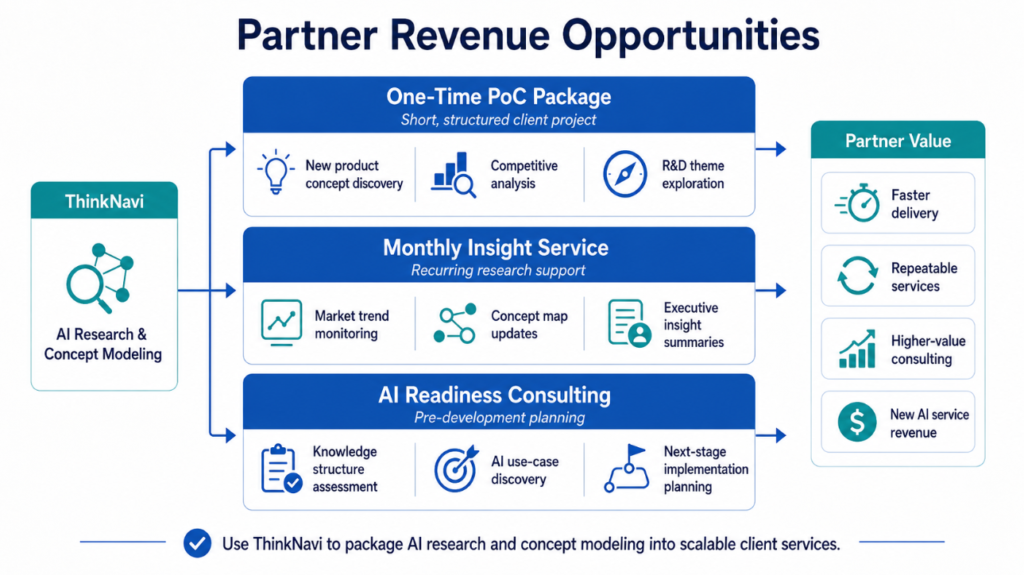
Possible Revenue Models for Partners
ThinkNavi is not intended to be resold simply as a software license.
The stronger model is to use ThinkNavi as a tool for providing client-facing research, concept modeling, and PoC services.
Model 1
One-Time PoC Package
Example services:
- AI research and concept modeling PoC
- New product concept discovery PoC
- Competitive analysis PoC
- R&D theme exploration PoC
- AI knowledge base readiness assessment
Possible pricing:
- Basic PoC: $750–$2,000
- Advanced PoC with report: $2,000–$5,000
- Larger strategic PoC: $5,000–$10,000+
Suitable for:
- Clients who want to test AI use cases before larger investment
- New business teams
- R&D departments
- Small and mid-sized companies exploring AI
- Consultants who want to offer a structured AI-related service
Model 2
Monthly Research and Insight Service
Example services:
- Monthly competitive trend monitoring
- Technology trend research
- Market change concept mapping
- New business theme exploration
- Ongoing concept discovery reports
Possible pricing:
- $500–$2,000 per month
- Higher pricing possible when combined with advisory meetings and executive reports
Suitable for:
- Companies that need continuous market intelligence
- R&D teams
- Product planning teams
- Strategy teams
- Small companies without internal research departments
Model 3
AI Implementation Readiness Consulting
Example services:
- AI adoption theme discovery
- Internal knowledge structure assessment
- AI knowledge base design PoC
- RAG / chatbot readiness assessment
- Pre-development concept modeling
Possible pricing:
- Initial assessment: $750–$2,000
- PoC project: $2,000–$10,000
- Full-scale implementation planning: custom quote
Suitable for:
- Companies considering AI system development
- Companies planning internal AI assistants
- Organizations that need to understand their knowledge structure before development
- Partners who want to connect PoC work to larger consulting or development projects
Important Positioning
ThinkNavi is not currently positioned as a full-scale enterprise knowledge base system for large-scale production operation.
At the current stage, ThinkNavi is best used for:
- AI research
- Concept modeling
- Concept map exploration
- Model interpretation
- Strategic theme discovery
- AI implementation PoC
- Early-stage knowledge structure assessment
If a client requires a full-scale enterprise AI system, secure internal deployment, large-scale data integration, advanced access control, or continuous production operation, ThinkNavi can be used as a PoC and planning tool before moving into dedicated development or custom implementation.
This makes ThinkNavi useful as a bridge between early-stage AI exploration and full-scale AI system development.
Future Direction
ThinkNavi will continue to evolve as an AI research and concept modeling platform.
Future development directions may include:
- AI chat in shared model viewers
- Model sharing with client-facing interaction
- Multiple-file model creation
- Client workspace management
- Usage and token tracking
- Stronger AI concierge features
- Business wiki generation
- AI knowledge base design support
- Mindware content integration
- Partner-oriented service templates
These future extensions are intended to make it easier for partners to provide AI research, concept modeling, knowledge structuring, and PoC services to their clients.
Recommended First Step
You do not need to begin with a large AI system project.
Start with one theme, one market, one technology domain, one competitor group, or one business problem.
Use ThinkNavi to collect information, build a concept-structure model, interpret the results, and create a client-facing PoC report.
From there, you can decide whether the client should proceed to:
- Further research
- Strategy development
- AI knowledge base design
- AI concierge development
- Custom AI system implementation
- Ongoing monthly research support
ThinkNavi helps you turn AI research and concept modeling into a practical business service.
*To start a business as a partner, you need to subscribe to a plan of “Small Business” or higher.