

A Concept Map is a method for visually representing relationships between concepts to organize, explain, and understand knowledge. Concepts are represented as nodes and connected by labeled lines that describe how they relate to one another.
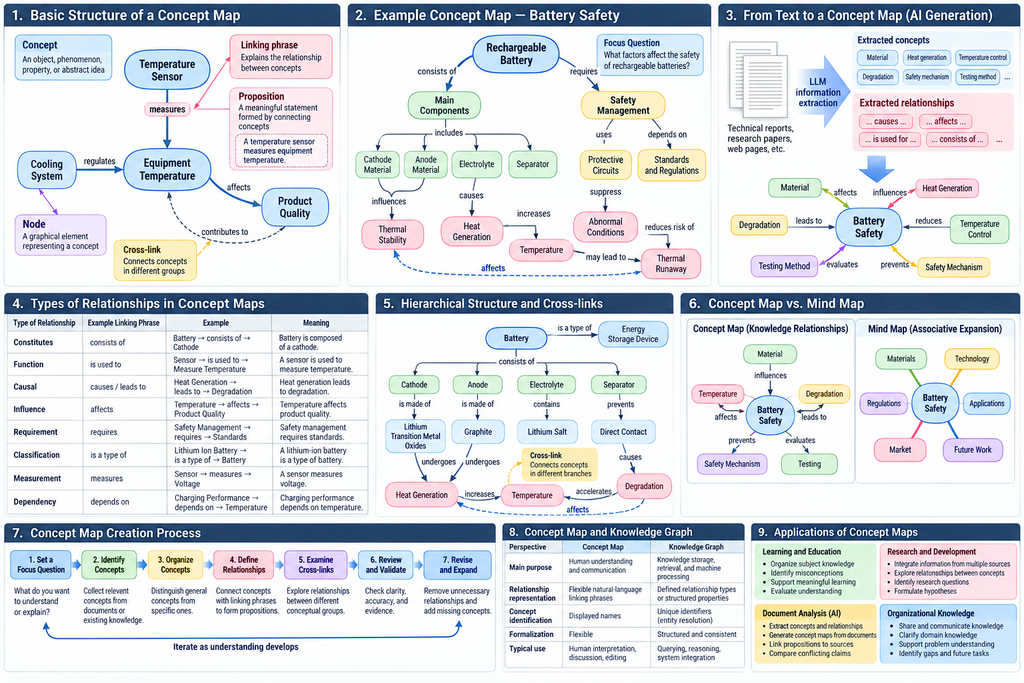
For example, consider four concepts: Temperature Sensor, Cooling System, Equipment Temperature, and Product Quality.
Simply connecting these concepts with lines does not explain the nature of their relationships.
However, statements such as “A temperature sensor measures equipment temperature,” “A cooling system regulates equipment temperature,” and “Equipment temperature affects product quality” express meaningful relationships that can be understood and examined.
While Mind Maps emphasize expanding associations radially from a central theme, Concept Maps emphasize the meaningful relationships that exist between concepts.
Concept Maps are used in education, knowledge organization, problem understanding, research and development, and organizational knowledge sharing. Examining relationships between concepts can also reveal gaps in understanding or questions that require further investigation.
Recent advances in large language models (LLMs) have made it technically possible to extract concepts and relationships from documents and automatically generate Concept Maps. However, the ability to generate a diagram does not guarantee that the diagram represents accurate knowledge.
Origins and Theoretical Background of Concept Maps
Joseph D. Novak, an American educational researcher, made important contributions to the development of Concept Mapping.
Novak developed Concept Maps in 1972 during research at Cornell University investigating the development of children’s scientific knowledge. The objective was to understand how learners acquired scientific concepts and connected new knowledge with what they already knew.
Novak and D. Bob Gowin subsequently presented Concept Mapping systematically as a method for supporting learning and understanding in their 1984 book, Learning How to Learn.
An important theoretical foundation of Concept Mapping is David P. Ausubel’s theory of Meaningful Learning.
Ausubel emphasized the importance of connecting new knowledge with the knowledge structures learners already possess.
For example, someone who understands the basic concept of electrical resistance can relate new information about material resistivity, temperature dependence, and heat generation to existing knowledge.
By contrast, memorizing terminology without understanding conceptual relationships may make it difficult to apply that knowledge to unfamiliar problems.
Concept Maps were developed as a means of externalizing how learners understand concepts and how those concepts are connected.
However, this does not imply that a Concept Map directly reproduces the structure of human memory or the actual processes of human thinking.
A Concept Map is a representation constructed to support understanding and communication. Its structure depends on the knowledge, objectives, and interpretations of the person creating it.
The Basic Structure of a Concept Map
A Concept Map generally consists of the following elements.
| Element | Function |
|---|---|
| Concept | Represents an object, phenomenon, property, or abstract idea |
| Node | A graphical element representing a concept |
| Linking Words or Phrases | Explain the relationship between concepts |
| Proposition | A meaningful statement formed by connecting concepts through linking phrases |
| Hierarchical Structure | Organizes relationships between general and specific concepts |
| Cross-link | Connects concepts belonging to different conceptual groups |
| Focus Question | Clarifies what the Concept Map is intended to explain or investigate |
Among these elements, propositions and linking phrases are particularly important.
A Concept Map does not merely place concepts next to one another. It represents relationships in a form that can be interpreted as meaningful statements.
What Is a Concept?
A concept represents common characteristics, properties, or regularities associated with objects, events, or phenomena.
For example, the concept of a metal is not simply a list of individual substances such as iron, copper, and aluminum. It represents a category of materials sharing certain characteristics.
Heat Conduction, Friction, and Degradation are also concepts.
Concepts do not necessarily refer to physical objects. They may represent phenomena, properties, functions, states, or abstract ideas.
By contrast, a record such as “The temperature measured at Equipment A on October 25, 2026” describes a particular observation.
Distinguishing individual observations from the broader concepts they exemplify is important when organizing knowledge.
Nevertheless, practical Concept Maps may include specific examples or product names to make explanations more concrete. In classical Concept Mapping, examples can also help clarify the meanings of concepts.
Propositions — The Fundamental Units of Concept Maps
A defining characteristic of Concept Mapping is the formation of propositions by combining concepts with linking phrases.
For example:
Temperature Sensor → measures → Equipment Temperature
This connection can be read as the proposition:
“A temperature sensor measures equipment temperature.”
Other propositions can be constructed in the same way.
| Concept A | Linking Phrase | Concept B | Meaning |
|---|---|---|---|
| Temperature Sensor | measures | Equipment Temperature | A temperature sensor measures equipment temperature |
| Cooling System | regulates | Equipment Temperature | A cooling system regulates equipment temperature |
| Equipment Temperature | affects | Product Quality | Equipment temperature affects product quality |
| Barcode Reader | reads | Component Identification Information | A barcode reader reads component identification information |
| Component Identification Information | is used for | Component Verification | Component identification information is used for component verification |
Connecting two concepts with a line is not sufficient to form a meaningful proposition.
For example, a line connecting Material A and Equipment B does not indicate whether Material A is used in Equipment B, processed by Equipment B, or affects its performance.
A relationship becomes more meaningful when expressed explicitly:
“Material A is used in the heat-resistant components of Equipment B.”
Such statements can be examined and evaluated as knowledge claims.
The choice of linking phrase can substantially change the meaning of a proposition.
For example, “A is related to B” is relatively vague.
More specific relationships, such as “A constitutes B,” “A measures B,” or “A suppresses the occurrence of B,” may provide more useful information when they can be justified.
However, specificity alone does not establish correctness.
A clearly expressed proposition is not necessarily a true proposition.
The validity of relationships represented in a Concept Map may need to be investigated or verified.
Hierarchical Structures and Cross-links
In the Concept Mapping approach developed by Novak and colleagues, hierarchical organization is emphasized.
More general concepts are typically placed above more specific concepts.
For example, the general concept Materials might be divided into Metals, Polymers, and Ceramics.
Metals could then be divided into more specific material categories.
Such structures can help organize relationships between general and specific knowledge.
However, a Concept Map is more than a hierarchical classification diagram.
Its ability to represent relationships between different conceptual groups is also important.
The Significance of Cross-links
Cross-links connect concepts belonging to different branches or conceptual groups.
For example, suppose a Concept Map of manufacturing operations contains three major areas: Equipment, Materials, and Quality Management.
The Equipment group contains Temperature Sensor and Cooling System.
The Materials group contains Heat Resistance and Thermal Expansion.
The Quality Management group contains Dimensional Accuracy and Defect Rate.
Classifying these concepts into separate groups does not adequately explain how the groups relate to one another.
However, additional propositions can connect them:
“Thermal expansion of materials affects dimensional accuracy.”
“Temperature control contributes to the management of thermal expansion.”
Such cross-links play an important role in integrating knowledge across conceptual domains.
Novak and colleagues also emphasized the potential importance of exploring cross-links for knowledge construction and creative thinking.
However, adding numerous cross-links does not automatically produce new discoveries.
It is necessary to clarify what relationships are being proposed and why they are important.
Is a Hierarchical Structure Essential?
Classical Concept Mapping recommends placing general concepts above more specific ones.
However, some subjects are better represented through cyclic relationships or networks connecting multiple conceptual groups.
For example, the water cycle, environmental systems, and business processes may be difficult to represent adequately through simple top-down hierarchies.
Concept Maps can accommodate such relationships through network-like structures.
Nevertheless, the arrangement of concepts remains important when the objective is to communicate knowledge clearly.
Establishing a Focus Question
Before creating a Concept Map, it is useful to clarify what the map is intended to explain.
Novak and colleagues refer to this as the Focus Question.
For example, the topic “Rechargeable Batteries” could lead to several different Concept Maps.
If the question is “What components constitute a rechargeable battery?”, the map might focus on cathodes, anodes, electrolytes, and separators.
If the question is “What factors affect rechargeable battery safety?”, the map might examine heat generation, material stability, charging and discharging conditions, and protective circuits.
If the question is “What opportunities exist for developing new battery safety technologies?”, the map might include alternative technological principles and unresolved problems.
Even within the same technical field, changing the question changes which concepts and relationships are relevant.
This illustrates that Concept Mapping does not automatically discover a single, uniquely correct knowledge structure inherent in the subject.
The structure of a Concept Map depends on what the user is trying to understand.
How to Construct a Concept Map
There is no single mandatory procedure for constructing a Concept Map.
However, the following activities provide a useful starting point.
| Activity | Description |
|---|---|
| 1. Establish a Focus Question | Clarify what needs to be understood or explained |
| 2. Identify Concepts | Collect concepts relevant to the question |
| 3. Organize Concepts | Distinguish general concepts from more specific ones |
| 4. Express Relationships | Connect concepts with linking phrases to form propositions |
| 5. Examine Cross-links | Explore relationships between different conceptual groups |
| 6. Review Propositions | Check clarity, accuracy, and supporting evidence |
| 7. Revise the Structure | Remove unnecessary relationships and add missing concepts |
There is no need to begin with a large number of concepts.
For example, a map can begin with approximately 10–20 concepts and expand as their relationships become clearer.
Concepts can also be collected in a temporary list before their relationships are established.
Novak and colleagues refer to such a collection of unplaced concepts as a Parking Lot.
The important point is not to force every concept into a relationship.
Concepts whose relationships remain unclear can be retained as unresolved questions.
Similarly, a Concept Map may need to be revised as new evidence or knowledge becomes available.
It should be treated as a representation that can evolve with understanding rather than as a diagram that must remain fixed once completed.
Practical Example — Understanding Quality Problems in Manufacturing
Consider a hypothetical application of Concept Mapping to dimensional defects in manufacturing.
A production process is experiencing variations in component dimensions after machining.
Relevant concepts might include:
Machining Temperature, Material Thermal Expansion, Dimensional Accuracy, Cooling System, Temperature Sensor, Machining Conditions, and Quality Inspection.
Simply listing these concepts does not explain how the problem occurs.
The next step is to examine their relationships.
Constructing Propositions
| Concept A | Relationship | Concept B | What Needs to Be Examined |
|---|---|---|---|
| Temperature Sensor | measures | Machining Temperature | Sensor location and measurement accuracy |
| Cooling System | is used to regulate | Machining Temperature | Control methods, capacity, operating conditions |
| Machining Temperature | may affect | Material Thermal Expansion | Material properties and temperature range |
| Material Thermal Expansion | may affect | Dimensional Accuracy | Machining and measurement conditions |
| Quality Inspection | evaluates | Dimensional Accuracy | Inspection methods and tolerances |
| Machining Conditions | may affect | Dimensional Accuracy | Process data and related factors |
This table distinguishes relatively clear functional relationships from causal hypotheses requiring verification.
For example, the relationship between a temperature sensor and the temperature it measures may be confirmed from equipment specifications.
By contrast, the claim that machining temperature is the primary cause of dimensional variation cannot be established without examining relevant evidence.
Questions Revealed by the Relationships
Constructing the Concept Map may reveal several questions.
Does the temperature sensor measure the relevant machining temperature accurately?
Is the measured temperature representative of the location where dimensional variation occurs?
Could thermal deformation of the machine itself contribute to dimensional variation, in addition to thermal expansion of the workpiece?
Such questions arise from attempts to express relationships precisely.
The map may need to include an additional concept, such as Machine Thermal Deformation.
The investigation might also reveal that dimensions measured during final inspection differ from those immediately after machining.
In this way, Concept Maps can be used not only to organize existing knowledge but also to identify missing concepts and relationships that have not yet been established.
However, determining the actual causes of dimensional defects requires measurements, statistical analysis, experiments, or other forms of investigation.
Constructing a Concept Map does not establish causation.
Concept Maps and Mind Maps
Concept Maps and Mind Maps both organize concepts and information visually.
However, they differ in their primary objectives and methods of representation.
A Mind Map generally expands words and images radially from a central theme.
For example, a Mind Map centered on New Product Development might contain branches for Materials, Customers, Quality, and Pricing.
A Concept Map, by contrast, would seek to express meaningful relationships such as:
“New product development considers customer requirements.”
“Material properties affect product quality.”
| Perspective | Mind Map | Concept Map |
|---|---|---|
| Basic Structure | Radial expansion from a central theme | Concepts connected through meaningful relationships |
| Main Purpose | Ideation, association, information organization, summarization | Understanding and representing knowledge relationships |
| Relationship Representation | Branches indicate associations | Linking phrases explicitly describe relationships |
| Hierarchical Structure | Organized around a central theme | Can organize general and specific concepts hierarchically |
| Cross-links | Sometimes used as supplementary connections | Important for connecting different conceptual groups |
| Typical Applications | Idea generation, note-taking, document summarization | Learning, knowledge sharing, relationship analysis, hypothesis exploration |
Modern Mind Mapping software may also provide cross-links and relationship labels.
Consequently, the capabilities of Mind Mapping and Concept Mapping tools sometimes overlap.
The important distinction is not the name of the diagram but how precisely the relationships between concepts can be expressed.
Concept Maps and Knowledge Graphs
Knowledge Graphs (KGs) are another technology related to Concept Maps.
Both represent concepts or entities as nodes connected through relationships.
However, they differ in their objectives and degree of formalization.
Concept Maps were originally developed to help people understand, explain, and communicate knowledge.
They therefore allow considerable flexibility in expressing concepts and relationships using natural language.
For example, a Concept Map might contain the proposition:
“Material A may be suitable for use in the heat-resistant components of Equipment B.”
In Knowledge Graphs designed for computational processing, the meanings of nodes and relationships generally need more explicit definitions.
For example, the relationship “is used in” must be distinguished from “may be suitable for use in.”
Knowledge Graphs often require consistent identifiers, relationship types, attributes, entity types, and provenance information.
| Perspective | Concept Map | Knowledge Graph |
|---|---|---|
| Main Purpose | Human understanding, explanation, knowledge sharing | Knowledge storage, retrieval, integration, machine processing |
| Relationship Representation | Flexible natural-language linking phrases | Defined relationship types or structured properties |
| Concept Identification | Concepts may be represented by their displayed names | Entity identification and resolution are important |
| Formalization | Flexible according to the intended purpose | Structured according to computational requirements |
| Typical Applications | Human interpretation, discussion, editing | Querying, reasoning, system integration |
However, Knowledge Graph is not the name of a single standardized technical architecture.
Some implementations use RDF, while others use property graphs or alternative representations.
It is also possible to transform information from Concept Maps into Knowledge Graphs.
However, such transformation may require resolving ambiguous expressions, identifying equivalent concepts, defining relationship types, and distinguishing facts from hypotheses.
Simply storing nodes and connections in a database does not automatically create a semantically consistent Knowledge Graph.
Concept Maps and Causal Diagrams
Concept Maps can represent many kinds of relationships.
Examples include “constitutes,” “is classified as,” “is used in,” “measures,” “affects,” and “requires.”
Not all relationships represented in a Concept Map are causal relationships.
By contrast, methods such as Causal Loop Diagrams focus on how changes in one variable affect changes in another.
For example, the hypothesis that increased production volume leads to increased equipment load requires consideration of the direction of influence, the behavior of variables, and possibly feedback effects.
A Concept Map can represent a statement about such a relationship.
However, it does not necessarily provide all the elements required for a quantitative causal model.
Concept Maps are useful for organizing the meanings of concepts and relationships.
When the objective is to analyze causal structures, feedback, or changes over time, methods such as Causal Loop Diagrams, Bayesian Networks, and statistical models may be more appropriate.
The representation should be selected according to the type of relationship being investigated.
The Relationship Between Concept Maps and the KJ Method
The KJ Method organizes fragments of information into meaningful groups through comparison and interpretation.
For example, statements collected from customer interviews can be recorded on cards and organized into groups.
Concept Mapping, by contrast, emphasizes identifying the relationships between concepts.
Suppose the KJ Method produces groups labeled Information Shortage, Operational Complexity, and Verification Burden.
A Concept Map can then examine relationships between these groups.
For example:
“Information shortages may increase the burden of verification.”
However, this proposition remains a hypothesis unless supported by evidence.
There is no requirement that KJ-style grouping must always precede Concept Mapping.
An investigation may begin by examining relationships among known concepts, or it may begin with grouping collected information before constructing a Concept Map.
The appropriate sequence depends on the available information and the objective.
Can Concept Maps Generate New Knowledge?
Concept Maps are frequently used to organize existing knowledge.
However, examining relationships between concepts may also lead to new questions and hypotheses.
For example, research and development activities may identify a relationship between the high-temperature resistance of a particular material and the requirements of equipment operating in a different industry.
Simply connecting the concepts of the material and the equipment does not establish a new technological opportunity.
The investigation must consider which properties of the material might address which technical problems associated with the equipment.
For example, a possible hypothesis might be:
“The thermal resistance of Material M may make it suitable for the high-temperature environment of Process P.”
Further investigation would need to consider processability, cost, strength, operating conditions, and other constraints.
In this example, connecting concepts from different domains provides a starting point for hypothesis generation.
However, whether the hypothesis is valid requires additional research or experimentation.
A Concept Map can help formulate new relationships, but it cannot guarantee that those relationships exist in reality.
Furthermore, forcing connections between concepts from unrelated fields can generate many superficial or meaningless associations.
The discovery of potentially useful relationships requires examining underlying functions, structures, constraints, and mechanisms rather than relying solely on conceptual similarity.
The Educational Effectiveness of Concept Maps
Concept Mapping originated in research on learning and education.
Constructing a Concept Map requires learners not only to remember concepts but also to consider how those concepts are related.
For example, when learning the concepts of Force, Mass, and Acceleration in physics, students must do more than place the three terms in a diagram.
They must explain the physical relationships that connect them.
Trying to express these relationships explicitly can reveal gaps or ambiguities in understanding.
Teachers can also examine students’ Concept Maps to identify misunderstandings or missing knowledge.
Nesbit and Adesope (2006) conducted a meta-analysis of learning with concept and knowledge maps and reported benefits for knowledge retention across several educational conditions.
However, effects varied according to the methods used and the comparison conditions, and differences existed among studies.
It would therefore be inappropriate to conclude that Concept Mapping is universally the most effective learning method for every subject and learner.
There is also an important distinction between constructing a Concept Map oneself and viewing a map automatically generated by AI.
The former requires the learner to consider and formulate relationships.
The latter may reduce that cognitive effort.
The convenience of automatic generation and the learning benefits of actively constructing relationships should therefore be evaluated separately.
AI-Generated Concept Maps
LLMs and other AI technologies can extract concepts and relationships from documents and use them to construct Concept Maps.
For example, technical reports may contain descriptions of materials, equipment, functions, performance characteristics, and constraints.
AI can identify these elements and extract relationships expressed in the text.
It may also be possible to integrate relationships extracted from multiple documents.
However, automatically generating Concept Maps introduces several important challenges.
1. Concept Extraction and Relationship Extraction Are Different
Identifying important terms in a document can support Concept Mapping.
However, identifying the terms does not automatically reveal their relationships.
For example, a report may mention Material A, Heat Resistance, and Equipment B.
This does not establish that Material A can be used in Equipment B.
Determining the relationship requires examination of the meaning and context of the relevant statements.
2. Relationships May Be Expressed Too Vaguely
AI-generated Concept Maps may overuse general linking phrases such as “is related to” or “affects.”
However, these phrases may fail to explain the actual nature of the relationship.
For example:
“Technology A is related to Performance B.”
is less informative than:
“Technology A may improve Performance B under Condition C.”
However, if the second statement is not supported by the source document, it must be treated as a newly generated hypothesis.
3. Facts and Hypotheses May Become Mixed
Suppose a paper reports:
“Material A exhibited high thermal resistance under specified conditions.”
An AI system might generate:
“Material A is suitable for high-temperature manufacturing processes.”
This is an inference from the paper, not necessarily an experimentally established fact.
Concept Maps should distinguish facts explicitly reported in sources, claims made by authors, interpretations developed by analysts, and newly generated hypotheses.
4. Concepts May Have Different Meanings Across Documents
The same term can be used with different meanings in different documents.
Conversely, different terms may refer to the same concept.
For example, Heat Resistance may refer to the ability to withstand short periods of high temperature in one document and resistance to long-term thermal degradation in another.
Combining these meanings without considering the distinction may produce incorrect relationships.
5. Large Concept Maps Can Become Difficult to Understand
Automatically extracting concepts from large document collections can produce many nodes and relationships.
However, displaying all of them in a single diagram does not necessarily make the information understandable.
It may be necessary to organize concepts into groups, select important relationships, or display only those portions of the structure relevant to a particular question.
AI-generated Concept Mapping therefore involves more than improving information extraction accuracy.
The analytical perspective used to organize knowledge, and the ability of people to examine the resulting relationships, are equally important.
Recording Sources and Verification Status
When Concept Maps are generated from large information collections, recording the evidence supporting each proposition becomes particularly important.
For example, the following information could be associated with each relationship.
| Information | Description |
|---|---|
| Concept A | The starting concept |
| Relationship | The linking phrase describing the relationship |
| Concept B | The target concept |
| Source | Academic paper, patent, internal document, or other reference |
| Supporting Passage | Location of the text or data supporting the proposition |
| Information Type | Observation, author’s claim, interpretation, hypothesis, etc. |
| Conditions | Temperature, environment, scope, or other relevant conditions |
| Verification Status | Confirmed, under investigation, unverified, etc. |
| Contradictory Evidence | Sources or observations that do not support the proposition |
With such information, users could select a relationship and examine why it was included in the Concept Map.
Differences between claims extracted from multiple documents could also be preserved.
For example, one study may report that a particular condition improves the durability of Material M, while another reports accelerated degradation under a different condition.
These findings are not necessarily contradictory.
Both may be valid under their respective experimental conditions.
The important point is to avoid merging them into one oversimplified relationship.
Concept Maps and Machine-Learned Concept Structure Models
Concept Maps and concept structure models generated through machine learning may sometimes be displayed using similar graphical representations.
However, their underlying principles differ.
For example, Growing Neural Gas (GNG) can learn nodes representing the structure of data according to their features and similarities.
Methods such as the Minimum Spanning Tree (MST) can also be used to organize connections among nodes.
In such models, node locations and connections are primarily determined by characteristics and distances derived from data.
By contrast, relationships in a Concept Map are defined by meaning, such as:
“A constitutes B.”
“A affects B.”
Consequently, two nodes being close together in a machine-learned representation does not necessarily imply that a particular semantic relationship exists between them.
Nodes connected by similarity must be distinguished from concepts connected by propositions.
Nevertheless, these approaches may be combined.
For example, machine learning could organize large information collections into conceptually related groups.
An LLM could then extract relationships from the documents associated with each group.
The resulting propositions could be displayed as Concept Maps that users can examine and evaluate.
Relationships between different conceptual groups could also be investigated.
However, whenever semantic relationships are inferred from similarity, the evidence and validity of those proposed relationships must be examined.
It is important not to confuse machine-learned similarity structures with representations of semantic knowledge.
Limitations of Concept Maps
Concept Maps have many applications, but they also have important limitations.
First, the selection of concepts and relationships depends on the knowledge and objectives of the person constructing the map.
Different people working from the same material may create different Concept Maps.
Second, expressing relationships clearly does not guarantee that they are correct.
Third, decomposing complex phenomena into simple propositions may fail to adequately represent conditions, changes over time, and interactions.
Fourth, as the number of concepts increases, the diagram may become too complex to understand easily.
Fifth, when completing the diagram becomes an objective in itself, users may prioritize visual consistency and exclude exceptional observations or contradictory evidence.
To avoid these problems, Concept Maps should be treated as representations for organizing and examining knowledge rather than as final conclusions.
There is no need to force unclear relationships or poorly understood concepts into an existing structure.
The fact that a relationship remains unknown can itself provide a starting point for further research and investigation.
Concept Maps in ThinkNavi
ThinkNavi treats Concept Mapping as a method for explicitly representing relationships within knowledge.
While Mind Mapping is particularly suited to associative thinking and organizing information into an overview, Concept Mapping makes it possible to formulate relationships as propositions and examine their meanings.
Concept Maps can also be used to explore relationships between information groups formed through the KJ Method or other classification techniques.
Furthermore, causal hypotheses represented in Concept Maps may be investigated using statistical analysis, Design of Experiments, Bayesian Networks, and related methods.
For ThinkNavi Free, a possible implementation would allow users to enter concepts and linking phrases manually and construct both proposition lists and graphical representations.
Potential LLM-assisted functions include extracting concepts and propositions from documents, organizing relationships, linking propositions to their sources, and comparing competing claims.
Another possible direction is combining Concept Mapping with machine-learned concept structure models.
Large information collections could be organized into conceptual groups, while semantic relationships within selected groups could be examined using LLMs.
These are potential directions for future development and do not imply that all such functions are currently available.
The value of Concept Mapping is not simply that knowledge can be arranged in an attractive diagram.
Attempting to explain the relationships between concepts can reveal areas where understanding is incomplete or supporting evidence is insufficient.
Moreover, examining connections between concepts from different fields may lead to questions and hypotheses that had not previously been considered.
Concept Mapping is not only a method for organizing what we already know. It is also a method for discovering what we do not yet understand.
Related Topics
- Mind Maps | From Associative Thinking to AI-Powered Summarization and Information Structuring
- The KJ Method | Building Meaningful Structures from Fragmented Information
- Brainstorming — Generating More Ideas by Suspending Judgment
- Analogy and Structure-Mapping Theory
- Concept Formation | How Categories Are Made
- Problem Structuring — Breaking Down Problems, Understanding Relationships, and Finding Paths to Solutions
- Logic Trees and Issue Trees — Breaking Down Problems and Identifying the Questions That Need Answers
- Systems Thinking | Interdependence and Change Over Time
- Causal Loop Diagrams | Understanding Feedback
- Root Cause Analysis (RCA) — Understanding Why Problems Occur and Preventing Recurrence
- Induction, Deduction, and Abduction — Discovering Patterns, Drawing Conclusions, and Generating New Hypothese
- The Scientific Method and Falsifiability — Generating Hypotheses and Testing Them Critically
- Bayesian Networks
- Qualitative and Quantitative Thinking — Two Perspectives on Understanding the World and Their Integration
- Concept Exploration
References and Further Reading
- Joseph D. Novak and Alberto J. Cañas, “The Theory Underlying Concept Maps and How to Construct and Use Them,” IHMC CmapTools Technical Report, revised 2008.
- Alberto J. Cañas and Joseph D. Novak, “What Is a Concept Map?,” Institute for Human and Machine Cognition.
- Alberto J. Cañas and Joseph D. Novak, “Constructing Your First Concept Map,” Institute for Human and Machine Cognition.
- Alberto J. Cañas and Joseph D. Novak, “Why the Focus Question?,” Institute for Human and Machine Cognition.
- Joseph D. Novak and D. Bob Gowin, Learning How to Learn, Cambridge University Press, 1984.
- David P. Ausubel, Educational Psychology: A Cognitive View, Holt, Rinehart and Winston, 1968.
- John C. Nesbit and Olusola O. Adesope, “Learning With Concept and Knowledge Maps: A Meta-Analysis,” Review of Educational Research, 76(3), 2006, pp. 413–448.
- IHMC CmapTools — Concept Mapping Software