

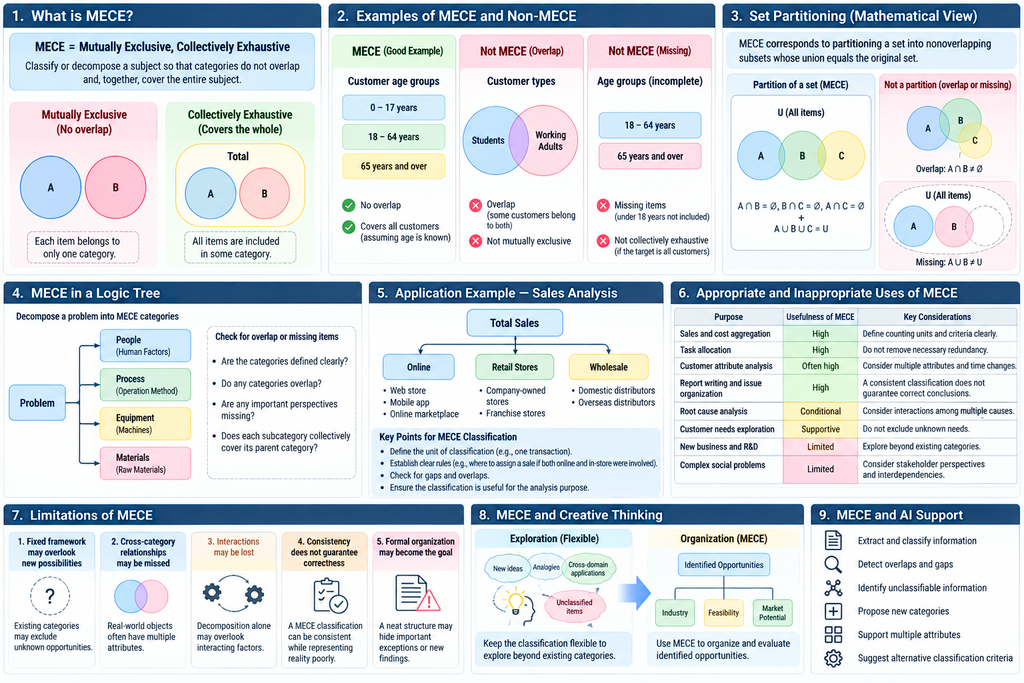
MECE (Mutually Exclusive, Collectively Exhaustive) is a principle for classifying or decomposing information so that categories do not overlap and, taken together, cover the entire subject under consideration. It is commonly explained as organizing information “without gaps or overlaps.”
For example, suppose a company wants to analyze sales by product category. If the same transaction is counted in multiple categories, double counting occurs. If some transactions are not assigned to any category, the results do not represent total sales.
To avoid these problems, the objects being classified and the definitions of the categories must be clearly established so that every item is assigned appropriately without duplication.
MECE became widely known through management consulting and is frequently presented as a fundamental principle of logical thinking. It is applied to Logic Trees, Issue Trees, business analysis, strategic planning, and many other activities.
However, MECE has important limitations.
When exploring unknown business opportunities, for example, the categories established at the beginning may not cover every possibility worth investigating. Real-world problems may also involve multiple interacting factors that cannot be assigned meaningfully to a single category.
MECE is useful for organizing a clearly defined set of objects consistently, but it does not guarantee the discovery of possibilities that have not yet been recognized.
Understanding MECE therefore requires more than knowing its logical definition. It is also necessary to consider when the principle is useful and when applying it too strictly may become counterproductive.
The Origins of MECE — McKinsey and Barbara Minto
The expression MECE was developed and popularized by Barbara Minto, who worked at McKinsey & Company.
Minto examined how consultants could organize information and arguments so that reports and recommendations would be easier for readers to understand.
This work led to the development of the Pyramid Principle.
The Pyramid Principle places the main message or conclusion at the top of a hierarchy, supported by subordinate arguments and evidence.
An important consideration is how arguments at the same level relate to one another and whether they adequately support the higher-level conclusion.
MECE developed as a principle for examining the organization and grouping of such arguments and information.
Minto herself has acknowledged coining the acronym MECE while explaining that the underlying principle of nonoverlapping classification is much older.
Indeed, the idea of dividing a set into mutually exclusive and collectively exhaustive subsets is found in mathematics, logic, and classification systems.
It would therefore be inaccurate to regard MECE as an entirely new logical principle invented by a management consulting firm.
Rather, it can be understood as the popularization of a general classification principle in a form suitable for business analysis, problem decomposition, and structured communication.
The Two Conditions of MECE
MECE consists of two conditions.
1. Mutually Exclusive — Categories Do Not Overlap
Mutual exclusivity means that categories do not overlap and that an individual item is not assigned to multiple categories within the same classification.
For example, customers could be classified by age as follows:
- Ages 0–17
- Ages 18–64
- Ages 65 and over
Assuming the ages of all customers are known, each person belongs to exactly one age category.
By contrast, a classification consisting of Students, Working Adults, and Older Adults is not mutually exclusive.
Someone attending university while working may belong to both the Student and Working Adult categories.
However, depending on the analytical purpose, the fact that someone possesses multiple attributes may itself be important information.
This issue is examined later.
2. Collectively Exhaustive — All Relevant Items Are Covered
Collective exhaustiveness means that the categories together include every item within the defined population or subject.
For example, if customers are divided into Ages 18–64 and Ages 65 and over, customers younger than 18 are excluded.
The classification is therefore not collectively exhaustive if the objective is to include all customers.
However, if the analysis explicitly concerns customers aged 18 and over, those two categories may be sufficient.
In other words, whether a classification is exhaustive depends on how the universe being classified is defined.
The Mathematical Principle of Partitioning a Set
The basic idea of MECE corresponds to the mathematical concept of a partition of a set.
A partition divides a set into nonoverlapping subsets whose union equals the original set.
For example, suppose a factory produces 100 products and classifies their inspection results as Pass or Fail.
If every product has been inspected and the acceptance criteria are mutually exclusive, this classification satisfies MECE.
However, if some products have not yet been inspected, the two categories do not cover the entire population.
Likewise, if the inspection criteria are ambiguous and some products could be classified as either Pass or Fail, mutual exclusivity becomes problematic.
Whether MECE is satisfied therefore depends on the objects being classified, the classification criteria, and the boundary conditions.
It is also important to recognize that the term MECE is often used more broadly in business analysis.
For example:
Revenue = Sales Quantity × Average Selling Price
This is a useful mathematical decomposition, but Sales Quantity and Average Selling Price are not mutually exclusive subsets of a set called Revenue.
Although this type of decomposition is sometimes described as an application of MECE, it should be distinguished from a partition in the strict mathematical sense.
Why Is MECE Considered a Principle of Logical Thinking?
Although MECE is fundamentally a classification principle, it is often introduced as an essential component of logical thinking.
This is because consistent classification is useful when explaining subjects logically or decomposing complex problems into manageable parts.
For example, suppose a company explains disappointing sales performance as follows:
“The causes are insufficient sales activity, declining advertising effectiveness, and inadequate sales promotion.”
However, Sales Activity and Sales Promotion may overlap.
Important perspectives such as product competitiveness, pricing, and distribution may also have been overlooked.
Applying MECE encourages analysts to examine whether the categories overlap or whether important perspectives have been omitted.
In this sense, MECE contributes to the construction of clear and logically organized explanations.
However, a classification satisfying MECE is not necessarily the same as a logically valid argument.
For example, the causes of a problem might be divided into Internal Factors and External Factors.
Depending on the definitions, this classification can be made mutually exclusive and collectively exhaustive.
However, if the problem results from interactions between internal and external factors, simply organizing the factors into two categories does not explain what caused the problem.
Similarly, investigating every category does not guarantee that the conclusions drawn from the investigation are correct.
Logical thinking involves many activities, including defining concepts, examining assumptions, evaluating inferences, and assessing evidence.
MECE is one principle for evaluating the consistency of classification and decomposition.
It does not encompass every aspect of logical thinking.
When Is MECE Useful?
MECE is particularly useful when the subject is reasonably well defined and information must be classified, aggregated, or allocated.
Sales and Cost Analysis
When aggregating sales by product, region, or distribution channel, it is important to establish consistent counting rules and avoid omissions or duplication.
For example, assigning each sales transaction to one primary product category allows category totals to be reconciled with overall sales.
However, consider a customer who sees an online advertisement but makes a purchase at a physical store.
Determining which distribution channel should receive credit for the sale requires an additional attribution rule.
A classification may be internally consistent without necessarily representing the most meaningful interpretation of the data.
Task Allocation and Progress Management
MECE can also help when dividing project activities among responsible individuals or teams.
It may reduce unnecessary duplication and identify tasks for which no one has been assigned responsibility.
However, some activities, such as quality assurance and safety verification, deliberately involve multiple independent checks.
Avoiding unnecessary duplication of work should not be confused with eliminating redundancy that provides valuable protection.
Problem Decomposition
MECE can be used when dividing a complex problem into smaller analytical questions.
For example, a decline in the customer base might be investigated through new customer acquisition and existing customer attrition.
However, a customer could be acquired and subsequently lost within the same reporting period.
The analysis must therefore distinguish customer states, events occurring during the period, and changes in customer counts between the beginning and end of the period.
An important requirement in problem decomposition is to clarify exactly what constitutes an individual unit of analysis.
How to Apply MECE
MECE is better understood as a principle for reviewing classifications and decompositions than as an independent procedure.
Nevertheless, the following activities provide a useful practical approach.
| Activity | Key Question |
|---|---|
| Clarify the purpose | Why is the information being classified? |
| Define the subject | What constitutes the complete population or universe? |
| Identify the unit of classification | Are we classifying people, transactions, products, events, causes, or something else? |
| Select classification criteria | Are categories based on age, region, function, process, or another criterion? |
| Define boundaries | What conditions determine the category to which each item belongs? |
| Check gaps and overlaps | Are there unclassified items or items assigned to multiple categories? |
| Evaluate usefulness | Does the classification help address the actual problem? |
| Revise when necessary | Should new information or alternative perspectives lead to a different classification? |
The important point is not to make satisfying MECE an end in itself.
For example, customers might be classified according to the first letter of their surnames.
With suitable rules, this classification could be made mutually exclusive and collectively exhaustive.
However, it would probably provide little value for understanding purchasing behavior.
Classification criteria should be chosen according to the subject and analytical objective.
MECE, Logic Trees, and Issue Trees
MECE is frequently used when constructing Logic Trees and Issue Trees.
A Logic Tree decomposes a problem or subject hierarchically.
For example, when investigating manufacturing defects, possible causes might be organized according to Materials, Equipment, Operating Methods, and Environment.
Applying MECE can help identify overlapping categories and potentially missing perspectives.
However, actual manufacturing defects do not necessarily belong to a single cause category.
For example, inappropriate equipment settings may involve both inadequate operating procedures and equipment design problems.
Forcing a contributing factor into only one branch may conceal relationships that are important to understanding the problem.
Issue Trees similarly divide a central question into smaller questions or issues.
In this case, avoiding duplication and identifying missing issues can be useful.
However, even a perfectly organized Issue Tree does not establish that the original problem was framed correctly.
MECE can help review the decomposition of a given problem, but it does not determine whether that problem is the one that should be investigated.
Limitation 1 — Overlooking Possibilities Outside the Initial Framework
Perhaps the most important limitation of MECE is that it assumes the universe to be classified has been appropriately defined.
Suppose a company wants to explore new market opportunities.
It divides its existing customers into three industries: Automotive, Electronics, and Machinery.
The categories may successfully classify the company’s current customers without duplication.
However, this does not mean that all future business opportunities are contained within those industries.
New applications might exist in healthcare, food production, construction, agriculture, or other sectors.
Consequently, exhaustively classifying existing customers is not the same as exhaustively exploring future market opportunities.
When MECE is overemphasized, existing categories may become fixed assumptions, making it less likely that opportunities outside the established framework will be considered.
This does not mean that the logic of MECE is incorrect.
The problem arises when the assumptions used to define the classification universe are left unquestioned.
Before evaluating whether a classification is MECE, it is necessary to examine what has been defined as the whole.
Limitation 2 — Overlooking Relationships Across Categories
Real-world people, products, technologies, and social phenomena often possess multiple attributes simultaneously.
For example, a customer may be both a student and an employee.
A technology may simultaneously belong to materials engineering, environmental technology, and medical applications.
Forcing such objects into a single category can conceal important aspects of their characteristics.
This is particularly significant in research and development and business innovation, where relationships across technological and industrial domains may create new opportunities.
For example, classifying a material technology under Chemical Materials does not eliminate its possible applications in medical devices or electronic components.
However, a fixed single-category system may make such cross-domain relationships more difficult to discover.
One possible solution is to retain multiple attributes rather than forcing each object into one category.
For example, a technology may be classified according to Material Type, Function, Applicable Industry, and Technological Maturity.
Different classifications can be used for different analytical purposes.
Each classification may be designed to satisfy MECE within its own defined context.
Making one classification dimension MECE is not the same as forcing every characteristic of an object into a single classification system.
Limitation 3 — Losing Interactions Through Decomposition
Complex problems frequently involve interactions among multiple factors.
Suppose a manufacturing defect occurs because of a particular combination of material properties and processing temperature.
Materials and Processing Temperature can be organized into separate categories.
However, if the defect depends on their interaction, examining each factor independently may fail to explain the problem adequately.
The important question is not simply whether the categories overlap.
It is how the factors interact.
Even when classification categories are mutually exclusive, the real-world factors assigned to those categories are not necessarily independent.
For example, a classification consisting of Equipment, Materials, and Operating Methods may contain no overlap in its definitions.
Nevertheless, compatibility between equipment and materials, or interactions between equipment and operating methods, may determine whether defects occur.
Such problems require analysis of interactions in addition to classification.
Statistical approaches such as Design of Experiments and Analysis of Variance can be used to investigate interactions among factors.
Systems Thinking and Causal Loop Diagrams can also help examine interdependencies and feedback.
MECE is useful for organizing elements, but it does not explain the relationships among those elements.
Limitation 4 — Classification Consistency Does Not Guarantee Correct Judgment
When a classification satisfies MECE, it can create the impression that the subject has been accurately understood.
However, consistency of classification is different from correctness of representation.
Suppose customers are divided into Price-Oriented, Quality-Oriented, and Brand-Oriented segments.
These categories may provide a useful starting point for discussing purchasing motivations.
However, a customer may consider both price and quality important.
The relative importance of these factors may also change according to the product or purchasing situation.
Even if each customer is assigned to exactly one segment through a predetermined rule, the classification may not accurately describe actual behavior.
A classification rule may be internally consistent while representing reality poorly.
Furthermore, conclusions drawn from classified data still require appropriate evidence and validation.
MECE is not a sufficient condition for obtaining correct conclusions.
Limitation 5 — Making Formal Organization an End in Itself
MECE is frequently used to improve the clarity of reports and presentations.
However, excessive attention to formal organization can encourage analysts to prioritize a neat explanation over the complexity of reality.
For example, the causes of a failed business initiative might be organized into three clearly defined categories.
The resulting presentation may be easy to understand and appear convincing.
Nevertheless, the investigation may have been incomplete, or important factors may have been excluded from those categories.
When unexpected information is discovered, analysts may also attempt to force it into an existing category to preserve the appearance of a complete classification.
This can result in significant exceptions or new findings being overlooked.
If information does not fit the existing categories, the classification framework itself may need to be reconsidered.
Producing a well-organized explanation is not the same as developing a deep understanding of a problem.
The Problem with the “Other” Category
An Other category is sometimes introduced to make a classification collectively exhaustive.
For example, customers’ occupations might be divided into several major categories, with all remaining occupations assigned to Other.
This can ensure that every customer is included.
However, if the Other category contains many items, the classification may not be suitable for the analytical objective.
It may also contain previously unrecognized types of objects.
For example, when exploring emerging industries, activities that do not fit established industrial classifications may be grouped under Other.
Important new sectors could then be overlooked.
The Other category should therefore not be treated merely as a container for miscellaneous items.
It can provide information about the limitations of the classification system and areas that are not yet adequately understood.
It may also be useful to distinguish between items that cannot be classified because information is missing and items that do not fit the existing categories at all.
The former may become classifiable after additional investigation.
The latter may indicate a need to revise the classification framework.
Problems for Which MECE Is More or Less Suitable
The usefulness of MECE depends on the analytical objective.
| Analytical Objective | Usefulness of MECE | Important Considerations |
|---|---|---|
| Sales and cost aggregation | High | Clearly define counting units and classification criteria |
| Task allocation and progress management | High | Preserve necessary redundancy and independent checks |
| Customer attribute analysis | Often high | Consider multiple attributes and changes over time |
| Issue organization and report writing | High | A consistent classification does not guarantee correct conclusions |
| Root Cause Analysis | Conditional | Consider interactions among multiple causes |
| Customer needs exploration | Useful as a supporting principle | Do not exclude unknown needs through existing classifications |
| New business and R&D theme exploration | Limited | Explore beyond established categories |
| Complex social problems | Limited | Consider stakeholder perspectives and interdependencies |
The decision is not simply whether to use MECE.
MECE can be useful when organizing known information, while a more flexible approach may be needed when exploring possibilities that have not yet been identified.
Once exploration produces new categories or concepts, MECE may again become useful for organizing and comparing the findings.
MECE and Creative Thinking — Classification Versus Discovery
Creative thinking sometimes requires discovering relationships that cross established categories.
Suppose a company possesses expertise in chemical materials and wants to identify new applications.
Organizing existing applications according to industrial classifications can provide a systematic view of current markets.
However, new applications may emerge at the boundaries between industries or through combinations of technologies originating in different fields.
Exploring these possibilities requires examining the underlying functions and properties of a technology rather than relying exclusively on its existing applications.
For example, technological capabilities might be abstracted into functions such as:
- Preventing oxidation
- Dissipating localized heat
- Modifying surface properties
The company could then explore other fields in which similar functions are needed.
In this approach, similarity of functions and underlying principles may be more important than established industrial classifications.
Attempting to construct one complete MECE classification at the beginning of such an exploration could unnecessarily restrict the range of possibilities considered.
However, once potential applications have been identified, classification becomes useful again.
Candidates can be organized and evaluated according to target industries, technical feasibility, application characteristics, and business potential.
MECE and creative thinking are therefore not necessarily incompatible.
Classification can remain flexible when expanding possibilities, while consistency becomes more important when organizing, comparing, and evaluating the resulting alternatives.
MECE and Problem Structuring
Problem Structuring examines how a problem should be understood and how its elements, relationships, and boundaries should be defined.
MECE can be used as one component of this activity.
For example, when addressing the challenge of improving manufacturing quality, MECE can help organize production processes and possible contributing factors.
However, Problem Structuring also involves questioning the initial definition of the problem.
Is reducing the defect rate the actual objective?
Should the inspection process be reconsidered?
Could the underlying issue involve product design or an inappropriate interpretation of customer requirements?
When the scope or definition of the problem itself needs to change, making the original classification MECE is insufficient.
For problems resembling the Wicked Problems discussed by Horst Rittel and Melvin Webber, the definition of the problem itself may be contested.
In such situations, establishing one complete classification in advance may be difficult or inappropriate.
MECE can help decompose a problem from a particular perspective, but it is not a method for exploring alternative problem definitions.
Problem Structuring should therefore distinguish the activity of decomposition from the activity of reframing the problem.
AI-Assisted MECE Analysis
LLMs and other AI technologies can support information classification and the identification of gaps and overlaps.
For example, AI can help classify customer feedback, organize arguments in reports, and structure operational problems hierarchically.
It may also identify semantically overlapping categories or items that do not fit an existing classification system.
However, the limitations of MECE remain when classification is automated.
In particular, an AI system instructed to assign information to predefined categories may force unexpected content into the nearest available category.
The resulting classification may appear orderly while concealing new types of problems or previously unrecognized characteristics.
It is therefore important to distinguish several types of AI-supported operations.
| Operation | Purpose |
|---|---|
| Classification into existing categories | Organize information according to a predefined classification system |
| Overlap detection | Identify duplicated information or overlapping categories |
| Identification of unclassifiable information | Find items that cannot be assigned appropriately to existing categories |
| Preservation of multiple attributes | Retain different characteristics associated with the same object |
| Proposal of new categories | Explore patterns not adequately represented by existing categories |
| Revision of classification criteria | Consider alternative perspectives better suited to the analytical objective |
A particularly important principle is not to discard information that does not fit existing categories merely because the classification system cannot accommodate it.
Such information may contain previously unrecognized problems or new concepts.
However, not every unclassifiable item represents an important discovery.
Some may result from recording errors, missing information, or exceptional circumstances.
Further investigation may be necessary to distinguish these possibilities.
MECE in ThinkNavi
ThinkNavi treats MECE as a logical thinking principle for evaluating the consistency of classification and decomposition.
It can support Logic Trees, Issue Trees, Problem Structuring, and other information-organization activities by identifying possible gaps and overlaps.
For example, when constructing a Logic Tree, a system might examine the classification criteria used at each level and identify categories that overlap or omit relevant elements.
It might also identify information that is difficult to classify within the existing framework and suggest reconsidering the analytical perspective.
Combining classification tools with Concept Maps or machine-learned concept structure models could also help represent relationships that cross categories or connect multiple classification perspectives.
For ThinkNavi Free, a possible implementation would allow users to enter classification targets, categories, and criteria and then examine potential gaps and overlaps.
Potential LLM-assisted functions include proposing classification frameworks, detecting semantic overlaps, extracting unclassifiable information, and suggesting alternative classification perspectives.
These are possible directions for future development and do not imply that all such functions are currently available.
When applying MECE in thinking-support systems, it is important not only to create internally consistent classifications but also to preserve information that does not fit those classifications and relationships that cross category boundaries.
Organizing known information efficiently and exploring possibilities that have not yet been recognized involve different kinds of thinking.
For the former, classification consistency is important.
For the latter, it may be necessary to change the classification framework or investigate objects that lie outside established categories.
The value of MECE is not that it allows us to classify every conceivable aspect of reality in advance. Its value lies in organizing information efficiently when the purpose and scope are clear. Discovering unknown problems and new possibilities requires the ability to question the classification framework itself.
Related Topics
- Logical Thinking — Building Sound Arguments, Communicating Reasoning, and Achieving Mutual Understanding
- Critical Thinking | Examining Claims and Evidence
- Logic Trees and Issue Trees — Breaking Down Problems and Identifying the Questions That Need Answers
- Problem Structuring — Breaking Down Problems, Understanding Relationships, and Finding Paths to Solutions
- Five Whys | Exploring Root Causes by Repeatedly Asking “Why?”
- The KJ Method | Building Meaningful Structures from Fragmented Information
- Mind Maps | From Associative Thinking to AI-Powered Summarization and Information Structuring
- Concept Maps — Representing Relationships Between Concepts and Understanding Knowledge Structures
- Concept Formation | How Categories Are Made
- Systems Thinking | Interdependence and Change Over Time
- Causal Loop Diagrams | Understanding Feedback
- Design Thinking — From Human-Centered Problem Discovery to Ideation, Prototyping, and Testing
- Induction, Deduction, and Abduction — Discovering Patterns, Drawing Conclusions, and Generating New Hypothese
- Qualitative and Quantitative Thinking — Two Perspectives on Understanding the World and Their Integration
- Design of Experiments (DOE) — Investigating Multiple Factors and Their Interactions Through Systematic Experimentation
- Concept Exploration
References and Further Reading
- Barbara Minto, The Minto Pyramid Principle: Logic in Writing, Thinking and Problem Solving, Minto International, 1996.
- Barbara Minto — The Minto Pyramid Principle
- McKinsey & Company — Barbara Minto: “MECE: I invented it, so I get to say how to pronounce it”
- Mitsubishi UFJ Research and Consulting — MECE (Japanese)
- GLOBIS Graduate School of Management — MECE (Japanese)
- ITmedia — MECE: Information Management Glossary (Japanese)
- Horst W. J. Rittel and Melvin M. Webber, “Dilemmas in a General Theory of Planning,” Policy Sciences, 4, 1973, pp. 155–169.
- Arnaud Chevallier, Strategic Thinking in Complex Problem Solving, Oxford University Press, 2016.
- Barbara Minto — Official Website